
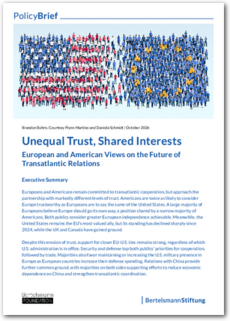
A drawing shows two groups of people who, through the colors of their clothing, together form the U.S. flag and the European flag, respectively. The two groups stand close together but are slightly separated from one another. In the middle between the two groups, there are only a few individuals wearing the U.S. or European colors, respectively.

Unequal Trust, Shared Interests: Support for a Rebalanced Transatlantic Partnership

Ahead of the 2026 U.S. midterm elections, a new joint study by our foundation and the Bertelsmann Foundation North America points to support on both sides of the Atlantic for pragmatic cooperation on shared interests and a more independent Europe. Trust remains profoundly unequal: Europeans are half as likely to consider the U.S. trustworthy as Americans are to trust Europe. Yet, majorities on both sides favor deeper EU-U.S. ties, while Canada leads preferences for stronger future partnerships.

Contact Person

Foto Brandon Bohrn
Brandon Bohrn

Content

As Americans prepare to vote in November, the new study, “Unequal Trust, Shared Interests – European and American Views on the Future of Transatlantic Relations,” reveals changing public expectations of the partnership. A profound trust gap shapes the relationship: 72 percent of Americans consider Europe trustworthy, compared with just 36 percent of Europeans who say the same of the United States.

Greater European independence finds support on both sides of the Atlantic, although the preference is much stronger in Europe. 73 percent of Europeans say Europe should go its own way after decades of close cooperation with the United States, a view shared by a narrow majority of Americans at 52 percent. Both publics also consider this goal achievable: 59 percent on each side believe Europe can realistically become more independent.

At the same time, Europeans and Americans want to strengthen ties with a wider range of partners. Canada leads their preferences for stronger future partnerships, selected by 36 percent of Europeans and 44 percent of Americans. The UK also features prominently as a desired partner, at 34 percent and 37 percent, respectively. Among Americans, the EU receives 37 percent, sharing second place with the UK. These preferences point to interest on both sides in a broader network of transatlantic partnerships.

Despite the desire for independence: Support for closer ties between the EU and the U.S.

Alongside their support for greater European independence and wider partnerships, majorities continue to favor deeper EU-U.S. ties. 62 percent of Europeans and 73 percent of Americans support strengthening the partnership regardless of which U.S. administration is in office. This support extends across the political spectrum on both sides of the Atlantic. Security and defense lead the priorities for cooperation, followed by trade, while reducing economic dependence on China provides further common ground.

Brandon Bohrn, our expert for transatlantic relations, argues: “Europeans want greater independence while continuing to see value in cooperation with the United States. Policymakers have public backing to strengthen Europe's own capabilities, broaden partnerships with countries such as Canada and the UK, and pursue practical cooperation with Washington where this is still possible and in both sides' shared interest. This shows that, despite the Trump administration's volatile and often confrontational stance towards the EU, these ambitions can reinforce one another as Europe takes greater responsibility for its future.”

Courtney Flynn Martino, Assistant Director for Transatlantic Relations at the Bertelsmann Foundation in Washington, D.C., adds: “Despite declining levels of trust, European publics still view the United States as their most valuable ally, and Americans demonstrate continued interest in closer ties with Europe. Coupled with near-identical priorities for areas of future cooperation, there remains numerous opportunities for the U.S. and Europe to engage constructively, even as the alliance becomes less centered on Washington and Brussels.”

Additional contact person for this article

Courtney Flynn Martino
Bertelsmann Foundation North America
Phone: +1 202 340 2735
E-Mail: courtney.flynn.martino@bfna.org 

Publication

Material