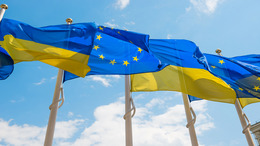
Ahead of this year’s Europe Day on May 9, Europeans are edging towards a strategic reset. Our new study, based on surveys conducted between September 2024 and March 2026, shows a continent willing to stand on its own feet. 73 percent of EU citizens now say the Union should go its own way after decades of close alignment with the United States; up from 63 percent in 2024. The shift cuts across all demographic groups, with particularly strong gains among older Europeans.

© Florian Bayer & Lucid.Berlin
Europeans call for greater independence: Support for U.S. as Europe’s Top Ally Drops Sharply
Europe is rethinking its place in the world. After decades of close cooperation with the United States, nearly three in four EU citizens now say the Union should ‘go its own way’. A clear majority of Europeans do not see the U.S. as a trustworthy partner any longer. A year and a half into the Trump presidency, the share of respondents identifying the U.S. as Europe’s most valuable ally has fallen by 20 percentage points. While China fails to gain ground as an alternative partner, Europeans are recalibrating alliances within the West. Our new study illustrates this shift.

Florian
Kommer
Senior Expert “European Strategic Issues”

Brandon
Bohrn
Content
The Trump presidency has left deep scars on the transatlantic relationship. Trust in the United States is low, with 58 percent of Europeans now saying they do not see Washington as a trustworthy partner. While the U.S. remains the EU’s most important ally in relative terms (31 percent), its standing has fallen by 20 percentage points since 2024. A polarizing American president and mounting geopolitical tensions have pushed European public opinion towards a more self-reliant stance.
Yet, Europe’s search for independence does not translate into a shift towards Beijing. China is viewed with persistent skepticism. Large majorities support reducing dependencies; even at economic costs. Instead, preferences are shifting within the existing alliance system. The United Kingdom and Canada are gaining importance as strategic partners, suggesting that Europeans are rebalancing rather than abandoning the transatlantic framework. Support for NATO remains solid, with clear majorities seeing it as a cornerstone of security (63 percent).
Florian Kommer, our Expert for European Strategic Issues, argues: "The message ahead of this year’s Europe Day is unmistakable: Europeans want to become more independent from the United States. Trust has eroded, America’s standing as Europe’s central partner has fallen. The partnership is not beyond repair, but our data point to a deeper, structural rift in transatlantic relations. European citizens are calling for greater independence, notably in foreign and security policy. Policymakers need to translate this call into detailed policies and a real investment in Europe’s own capabilities."
Brandon Bohrn, our Expert for Transatlantic Relations, adds: "As Washington’s foreign policy has become unreliable, deepening ties with like-minded partners such as the United Kingdom and Canada is becoming essential. In this context, building a stronger and more self-reliant Europe goes hand in hand with expanding its partnerships to ensure greater resilience and strategic stability."

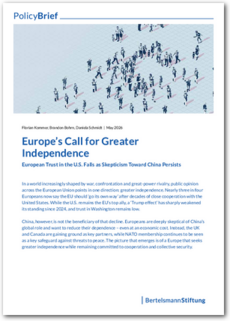
Materials
Additional information:
eupinions is a European opinion research tool developed by the Bertelsmann Stiftung and conducted by Nira Data. eupinions regularly surveys citizens in all 27 EU member states on European issues. The surveys for this analysis were conducted between September 2024 and March 2026 in the EU and the United Kingdom. Details of the survey methodology are included in the publication.