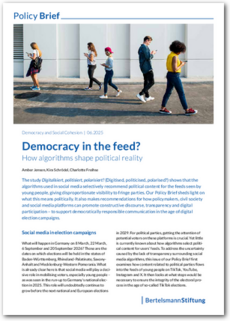
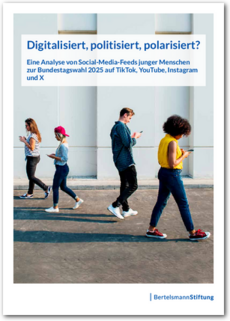
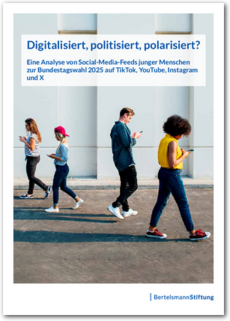
Social media has become the most important source of information about politics for young people – but what they see there is no coincidence. The latest study, "Digitised, politicised, polarised? – An analysis of young people's social media feeds on TikTok, YouTube, Instagram and X for the 2025 federal election" by the University of Potsdam in cooperation with the Bertelsmann Stiftung shows that recommendation algorithms on TikTok, X, Instagram, and YouTube display content from parties at the political extremes significantly more often in young users’ feeds than content from centrist parties.
![[Translate to English:] Mehrere jungen Menschen mit einem Handy in der Hand, die umherlaufen](/fileadmin/files/_processed_/e/b/csm_AdobeStock_458153270_KONZERN_ST-DZ_Office_9b024a7aca.jpg)
© Rawpixel.com - stock.adobe.com
Algorithms in election campaigns: A study by the University of Potsdam and the Bertelsmann Stiftung shows an imbalance in the visibility of political parties in young people's social media feeds
It has never been so easy for politicians to get attention in the everyday life of voters, as these days through social media. But what young people see about politics in their social media feeds is determined by platform algorithms. The study “Digitised, politicised, polarised?” (in German “Digitalisiert, politisiert, polarisiert?”) shows that algorithms play videos from parties at both ends of the political spectrum more frequently, while posts from the political center appear less often in feeds. Even if centrist parties post more frequently in comparison, they are less visible in feeds. To ensure the integrity of future elections, there needs to be a social and political discourse on the role of social media platforms in times of digital election campaigns.

Amber
Jensen
Project Manager

Kira
Schrödel
Project Manager
Content

Bertelsmann Stiftung
The figure shows the exposure of videos posted by official party accounts to TikTok users. It compares what the parties uploaded (percentage points on the left) with how visible these videos were in users’ feeds (percentage points on the right).
A loss of visibility
Comparing the number of videos uploaded by official party accounts between 1 January and 23 February 2025 to TikTok, it is striking that the SPD posted the most, with a share of 24.1 per cent. However, in the feeds of user profiles (aged 21-25), the SPD was only visible 14.1 per cent of the time – a ten per cent loss of visibility in the feeds. The CDU/CSU also lost visibility due to the recommendation algorithm – it posted 17.1 per cent of the videos from official party accounts but only appeared in 4.9 per cent of young users' feeds. The parties at the political extremes, on the other hand, benefited: while the AfD accounted for 21.5 per cent of uploaded videos, it was suggested to young users almost twice as often in feeds, at 37.4 per cent. Die Linke was able to almost triple its visibility: it posted 9.7 per cent of the videos from official party accounts but appeared in feeds with a share of 27.6 per cent of the videos that appeared.
Bertelsmann Stiftung
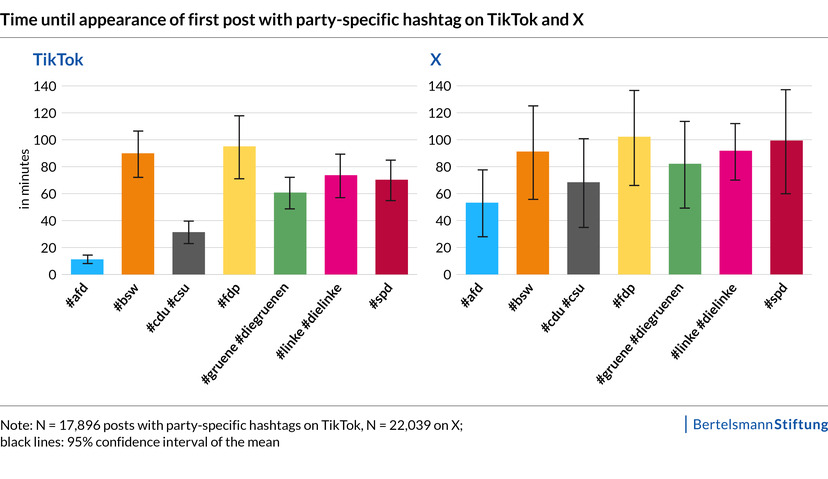
The two graphs show how long it took on each platform for users to be exposed to political content after first registering. Specifically, they show the time until the first post with a given party hashtag appeared. The graph illustrate the comparatively short time frames on TikTok and X (up to 140 minutes).
In the 2025 federal election campaign, political videos related to the AfD were also suggested fastest. After creating a user profile on TikTok, videos with #afd were displayed within an average of eleven to twelve minutes. It took on average 70 minutes for a video with #spd to appear. Proportionally, videos with #afd were displayed most frequently across all platforms (around 50 per cent of all party-related content on TikTok, X, Instagram and YouTube).
Recommendation algorithms now determine which political messages reach young people. If centrist parties are structurally less visible in the digital space, this puts at risk the balance of digital election campaigns.
Amber Jensen, Project Manager at Bertelsmann Stiftung
Platforms can influence what young users see
Due to the lack of transparency surrounding platform algorithms, it is impossible to determine conclusively why some parties gain more visibility with their videos than others. The data suggests that factors such as comments, likes, views and the style of the videos have an impact on the algorithm – but cannot fully explain the differences in how the videos are played.
Feeds are no neutral spaces. They reflect algorithmic preferences. Whether the digital public sphere will reinforce polarisation or enable constructive discourse in the future depends on how we communicate and regulate now.
Kira Schrödel, Project Manager at Bertelsmann Stiftung
More transparency and responsibility
The accompanying Policy Brief contextualizes the study’s results politically and provides concrete recommendations for action:
- In the short term, parties that so far have been underrepresented in their presence on platforms such as TikTok should increase their presence, e.g. by utilizing additional accounts and promote respectful, dialogue-oriented communication there.
- In the medium term, digital education and self-determination over social media feeds must be strengthened to enable young people to understand and critically question algorithmic mechanisms.
- In the long term, compulsory transparency requirements for platforms are needed.
Additional information
The study "Digitised, politicised, polarised? – An analysis of young people's social media feeds on TikTok, YouTube, Instagram and X for the 2025 federal election" (in German; “Digitalisiert, poltisiert, polarisiert?” was conducted by the University of Potsdam and the the Bertelsmann Stiftung. Using 268 user profiles (‘sock puppet audits’) the study analyzed 2.6 million videos. Thereby the study analyses what political content was displayed to young people (aged 21–25) on TikTok, YouTube, Instagram and X in the run-up to the 2025 federal election from 22 January to 23 February 2025.