74 percent of 16- to 27-year-olds obtain political information via social media, ahead of school (60%), family (58%), friends (54%) and traditional media such as newspapers or television (46%). While 38 percent of respondents specifically follow political parties or politicians, the majority follow political influencers (60 percent); about half of young users report seeing political content primarily in algorithmically selected feeds. However, active participation remains limited, with only 17 percent participating in online discussions themselves and only about one in five regularly liking or commenting on political posts.

Daniel Menzel, basierend auf einem Design von Greta Fleck
How to Sell Democracy Online (Fast)
Young people in Germany today primarily get their information through social media channels such as Instagram and TikTok; this is shown by the study How to Sell Democracy Online (Fast), conducted by the Proressive Zentrum in cooperation with the Bertelsmann Stiftung and supported by the Mercator Sitftung. The aim is to strengthen democratic actors in their social media presence and further develop their media literacy so that they can offer young people information and identification opportunities. The results clearly show that there is a gap between the content that politicians produce for young people and what actually appeals to young people and invites them to engage in genuine discussion. Accordingly, the study contains concrete recommendations and a one-pager entitled “How to sell in a nutshell.”
#Democracy #SocialMedia #Politics #YoungPeople

Sibylle Sophie
Gröbel
Project Manager

Kira
Schrödel
Project Manager

Amber
Jensen
Project Manager
Social media is the main source of political information for young people
Which topics achieve reach, and which do not
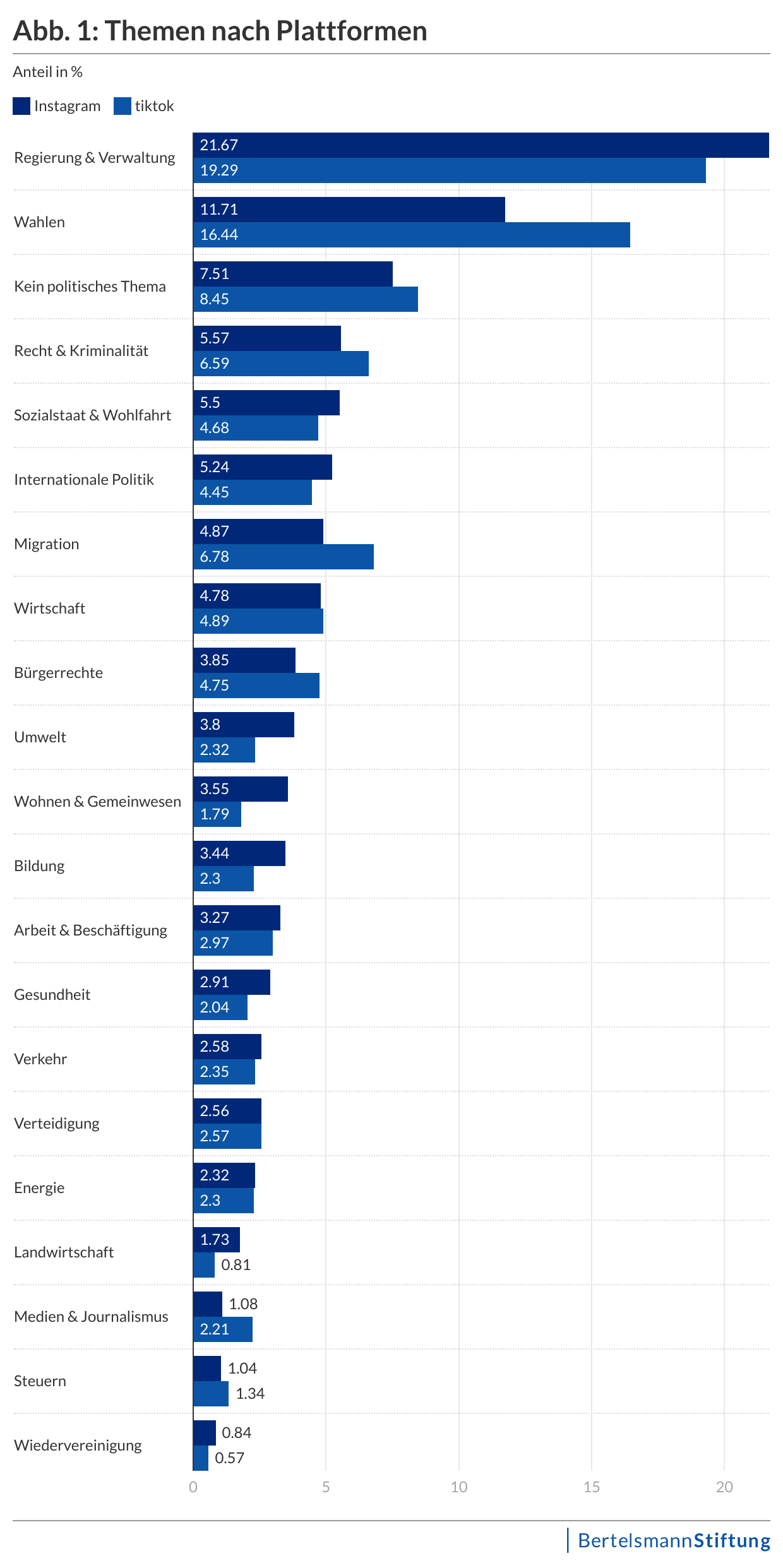
More than one in three political videos on TikTok or Instagram in the second half of 2024 focused on government and administration (21%) or elections (17%). These top topics rarely refer explicitly to the needs and perspectives of young people. Videos about migration were viewed around 11 percent more often on average. The attitudes expressed in these videos were not recorded. Posts about elections (+8%) and videos without political references (+9%) also significantly increased reach. In contrast, the focus on social policy (-7%), the environment (-18%), and education (-17%) had a negative effect. The topic rarely plays a role on the platforms (3% education), but has an above-average explicit youth reference (+9 percentage points). However, videos about education have a significantly lower reach (-17 percentage points).
Tone: Positive self-presentation and attacks have different effects
The analysis shows that a large proportion of the posts contain positive self-presentation (70%), while around 35 percent of the posts contain attacks on political opponents. On average, attacks are viewed significantly more often than comparable content without attacks, but the survey suggests that many young people view such attacks critically and reject the denigration of others in short videos. Positive self-presentation occurs more frequently on Instagram, while attacks occur more often on TikTok; these differences are reflected in the distribution and type of reach.
What young people desire and what that means for politics
For political actors, the results show that today a presence on TikTok and Instagram is essential because both platforms are the central sources of political information for young people. At the same time, mere presence is not enough: it is imperative to take young peoples’ current reality seriously and to address it in political communication. Especially when it comes to the future, it should not sound abstract and detached from everyday life. Short video formats can enable genuine interaction and thus essential democratic discourse between politics and young people.
All results and 13 recommendations for political actors on how to reach young people more effectively on social media can be found in our publication “How to sell democracy online (fast)”.
Executive Summary and Study


Materials
- Fig. 1 Topics by Platform
- Fig. 5 Attacks and Acclaims by Party Affiliation
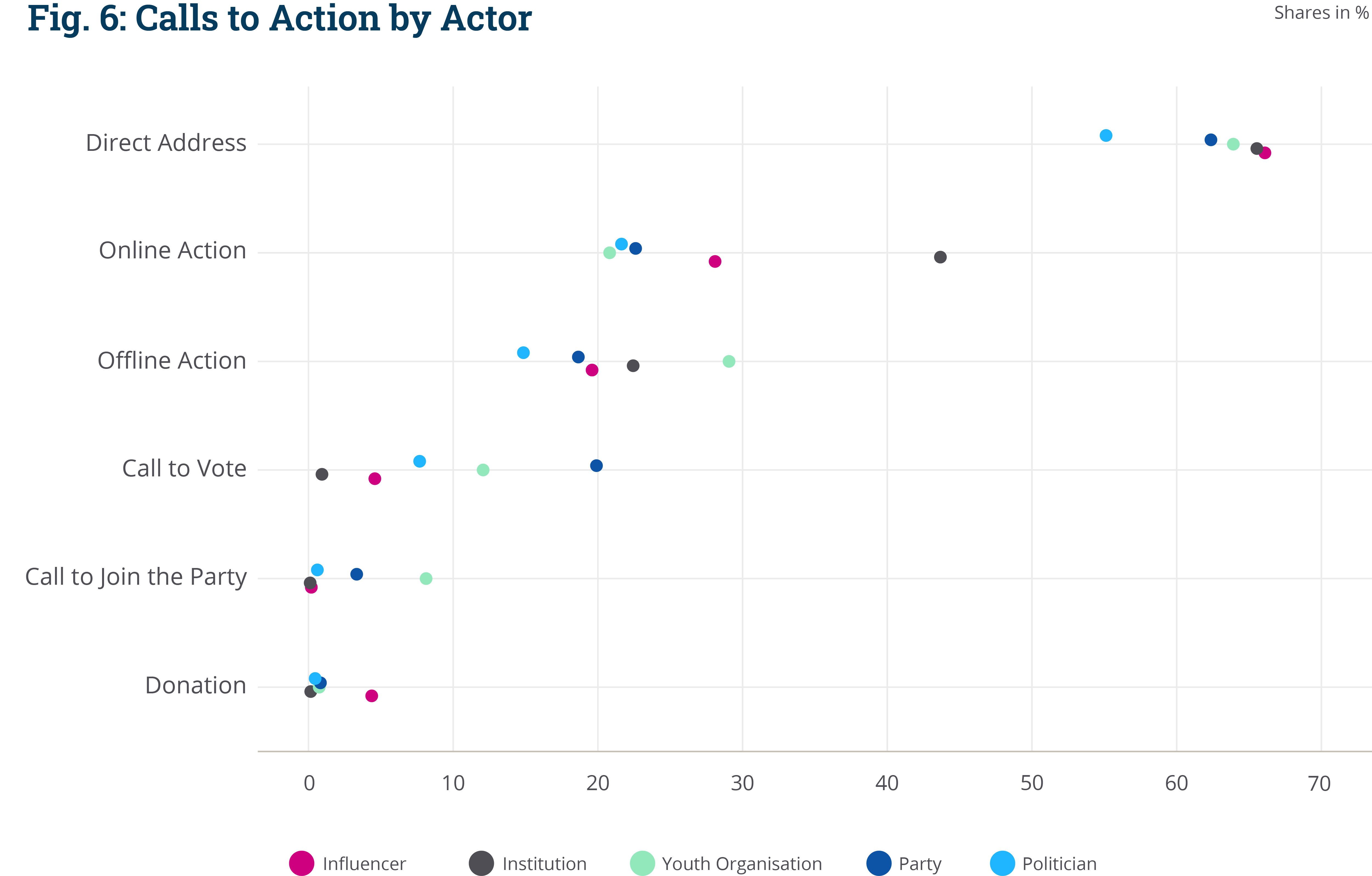
- Fig. 6 Calls to action by actor
- Fig. 8 Affordances by Actor
- Fig. 10 Impact of Features on Number of Views
- Fig. 12 Places of Contact with Politics
- Fig. 14 Use of Political Content by Politicians
- Fig. 16 Opinion on Politicians Content on Social Media
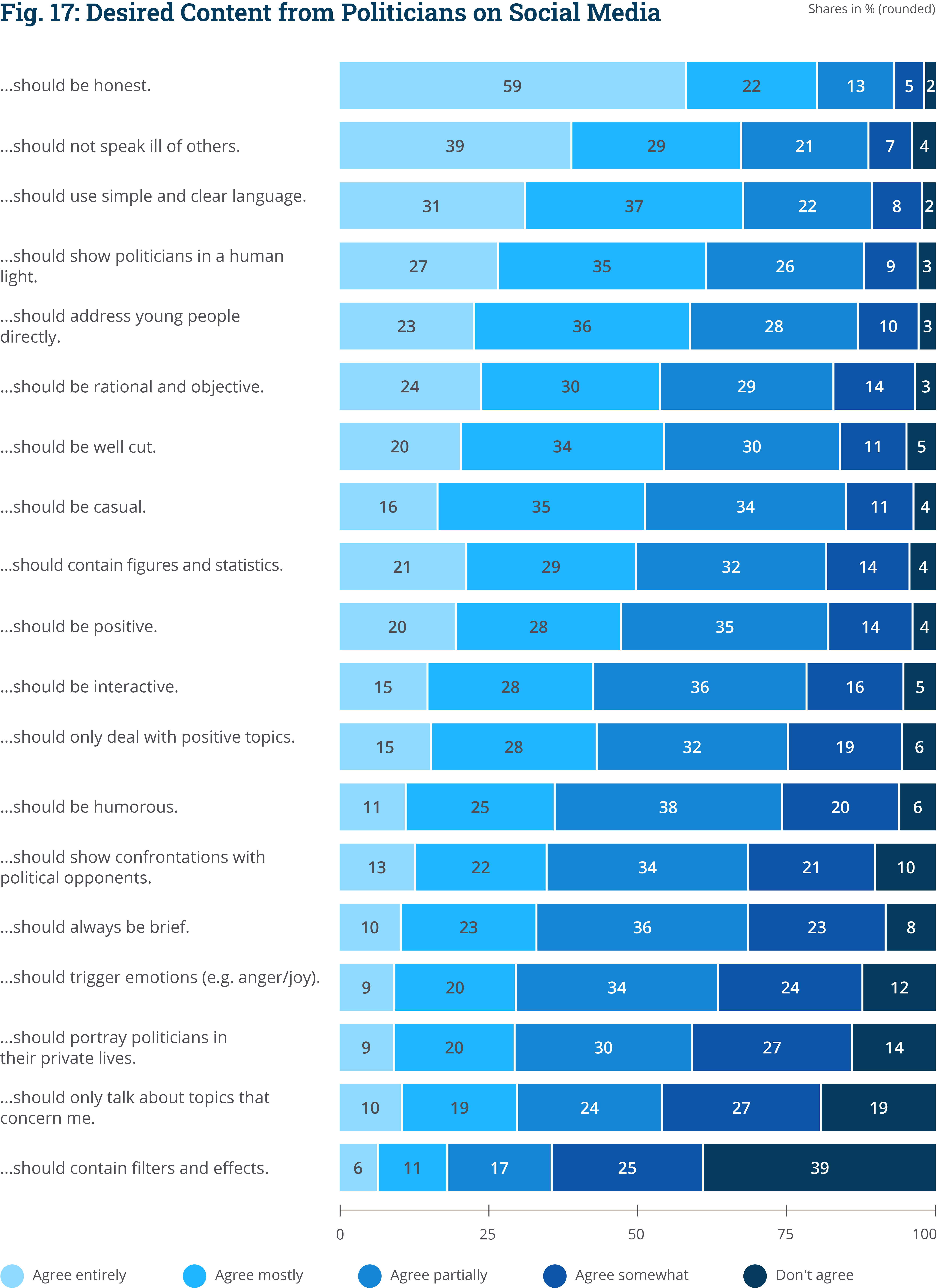
- Fig. 17 Desired Content from Politicians on Social Media
Methodological notes on the study
The study How to Sell Democracy Online (Fast) is based on an AI-supported evaluation of some 31,000 short videos on TikTok and Instagram between June and December 2024 from 1,976 political accounts done by a scientific team at Johannes Gutenberg University Mainz led by Dr. Pablo Jost.
In addition, a content analysis was conducted by the opinion research institute pollytix strategic research gmbh through a representative online survey of 1,748 [KS1] young people aged 16 to 27, as well as four focus groups in the age groups 16 to 19 and 20 to 25 with a total of 27 young people.
In addition, the team at Johannes Gutenberg University Mainz conducted a selection experiment in which young people were shown the first 5 seconds of political content to determine which content features increase the likelihood that users will continue watching a short political video.