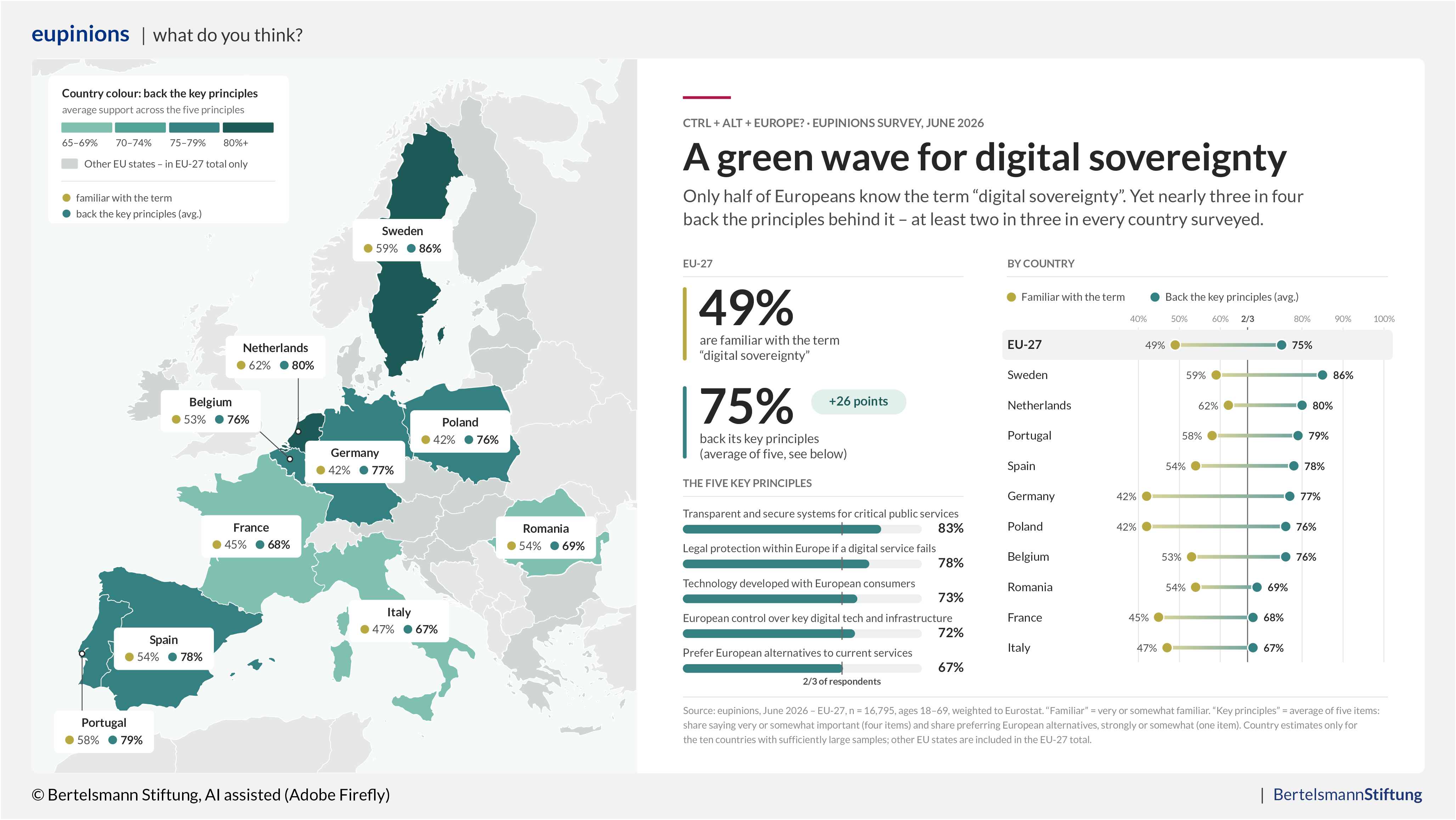
Europeans have clear expectations of their digital future. In our new survey across all 27 EU member states, 72 percent say it is important for Europe to control key digital technologies and infrastructure, including cloud services, networks, software and AI. Almost as many, 73 percent, are concerned that actors outside Europe could remotely disable critical digital services. However, the language of the political debate has yet to reach many of them: Only 49 percent say they are familiar with the term “digital sovereignty”.

KI-generiert (Adobe Firefly)
Most Europeans support homegrown digital alternatives, but the European debate hasn't yet fully matched that ambition
Our new survey finds broad support for European digital alternatives, greater European control over key technologies and secure, reliable access to public services. Across the EU, 67 percent would prefer European AI tools, social media and cloud services to those they currently use, provided they offer comparable functionality. Europeans should combine investment in digital technologies with effective regulation and build open, interoperable and decentralised infrastructure. Policymakers are called on to explain how these efforts will give Europeans the control and trustworthy services they expect.

Martin
Hullin
Director, Network for Technological Resilience & Sovereignty
Content
“People understand what is at stake, when essential services depend on decisions made elsewhere,” says Martin Hullin, Director Network for Technological Resilience & Sovereignty in our Europe’s Future Program. “They want technology they can rely on, clear rights they can enforce, and alternatives built on verifiable, trusted infrastructure. This is something Europe is uniquely positioned to provide for itself and for trustworthy partners beyond it, but we need clearer language for the public, so that everyone can fully recognise and drive this ambition.”
The survey shows what Europeans expect in practice. 83 percent consider it important that digital systems used for critical public services, such as healthcare, elections and the judiciary, are transparent and secure. Another 78 percent want access to legal remedies within Europe if a digital service causes harm or fails. For 69 percent, data should be stored and processed in Europe and remain under European ownership.
Support for European control is particularly strong around the political centre. It stands at 79 percent among centre-left and 75 percent among centre-right respondents, compared with 41 percent among those on the far right. Confidence in Europe's current response is less widespread. Asked whether Europe successfully regulates digital services from outside the continent in line with its fundamental values, 43 percent of respondents agree, 43 percent disagree and 14 percent say they cannot judge.
The study calls on European policymakers to combine investment in technological capabilities in combination with effective regulation. It recommends more focus on open, interoperable and decentralised infrastructure that reduces dependence on individual providers and enables public scrutiny. Policymakers should also explain these goals in accessible language, framing digital sovereignty as a strong and internationally competitive vision for Europe's digital future, with trust and credibility at its core.

Material
- Chart: How important is it to you that Europe has control over key digital technologies and infrastructure (e.g., cloud services, networks, software, AI)?
- Chart: Would you prefer European alternatives to AI tools, social media, cloud etc., if they offered similar functionality to current services?
- Chart: Do you think Europe is successful in regulating digital services from outside the continent (platforms, AI, software, etc.) so that they align with its core values?
- Overview chart: A green wave for digital sovereignty
Additional information
eupinions is a European opinion research tool developed by the Bertelsmann Stiftung and conducted by Nira Data. eupinions regularly surveys citizens in all 27 EU member states on European issues. The survey for this analysis was conducted in June 2026. Details of the survey methodology are included in the publication. For more information, please visit our website: www.eupinions.eu.
The European Network for Technological Resilience and Sovereignty (ETRS), founded a year ago, brings together research expertise across Europe to build a shared understanding of digital sovereignty and translate the concept into practical policies that strengthen Europe’s technological independence. For more information, please visit: www.bertelsmann-stiftung.de/en/unsere-projekte/european-technological-resilience-sovereignty-etrs.