

The annual Community Roadmap update is now complete. This means the data – most of which come from Germany’s state and federal statistical offices and the Federal Employment Agency – are accessible for the year 2023. The portal covers 14 topics and includes over 320 individual indicators for historical data alone. From employment statistics for women to birth rates to figures on commuter flows, comparative data are available for all of Germany’s municipalities with at least 5,000 inhabitants. The detailed data make precise analyses possible and cover around 89 percent of the country’s population. The portal also includes the territorial changes that became effective on December 31, 2024.
Valeska Achenbach
Wegweiser Kommune: 2025 data update now complete
From employment data for women to birth rates to poverty in old age, the Wegweiser Kommune (Community Roadmap) provides access to municipal data for 14 topics. The portal has now been updated with data for 2023, the latest year available. Regional differences are particularly pronounced for one indicator.
Content
Regional difference in poverty among the elderly
How many of Germany’s elderly depend on government assistance? The Community Roadmap provides answers to that question based on figures available through 2023. It also shows there are significant differences between Germany’s eastern and western states.
A total of 321 indicators have been updated for our historical data. The indicators cover the subjects demographic change, education and training, employment and labor market, finance, integration, childcare, sustainability/SDGs, commuting, nursing care, schooling and social conditions. It is now possible to create time series coving the period 2006 to 2023. The latter is the most recent year available from the country’s statistical offices.
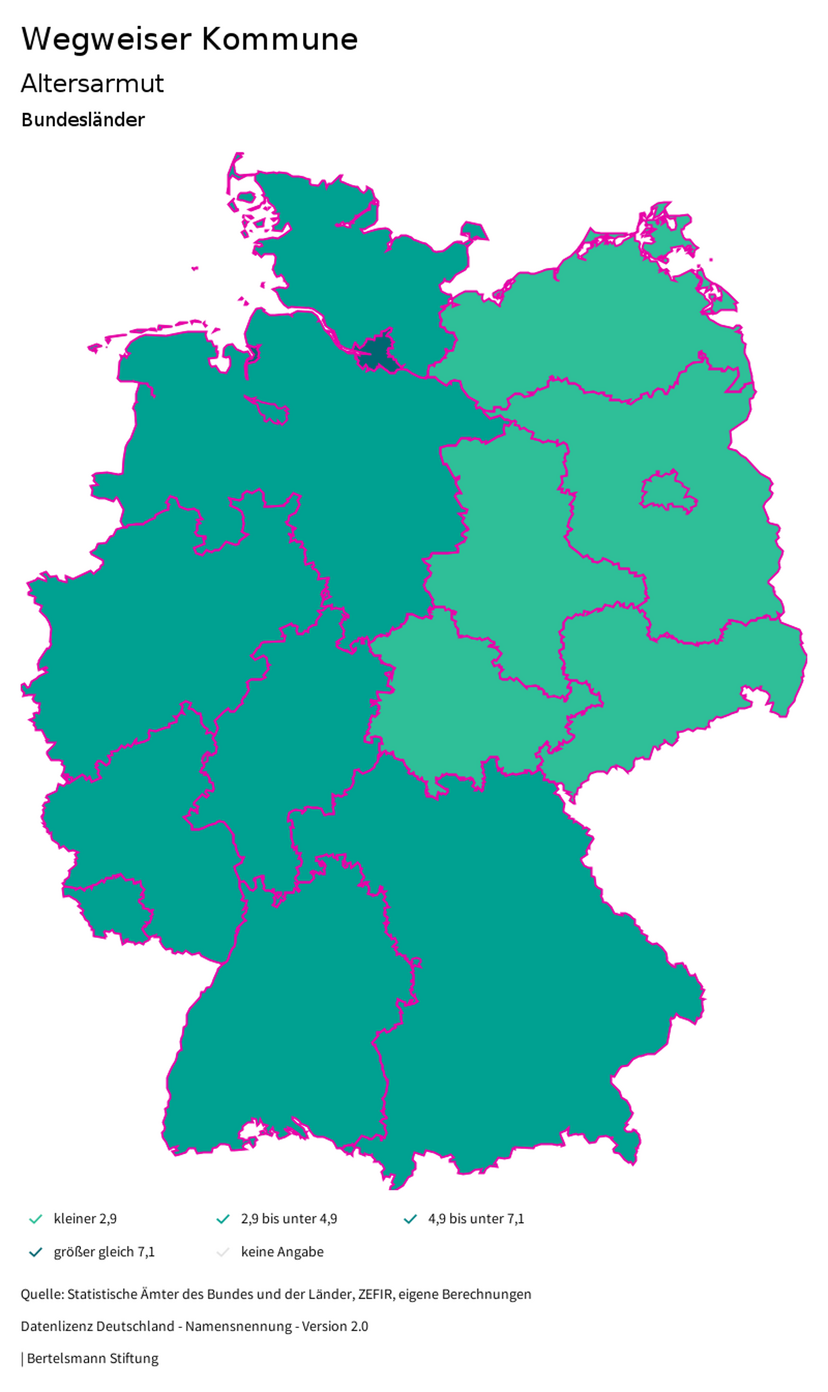
One insightful indicator that has been updated for 2023 is poverty among the elderly. This indicator shows the share of the population 65 years and older that receives basic benefits in accordance with Germany’s social assistance laws.
Looking at this indicator at the state level, one difference becomes apparent between Germany’s eastern and western regions. All of the major states in the east have values of less than 2 percent. The old-age poverty rate is lowest in Thuringia, at only 1.4 percent. The figures are significantly higher in the west. Here, the leader among the major states is North Rhine–Westphalia, at 4.7 percent, closely followed by Hesse at 4.6 percent. Only in the city-states are the rates even higher, reaching 9.7 percent in Hamburg. This means that almost one person in 10 in Hamburg over 65 receives a basic subsistence income from the government. Possible explanations for these notable differences could be the different employment histories of people in eastern and western Germany. In the states that once made up East Germany, for example, many people worked full time at jobs requiring contributions to social security programs. In West Germany, women tended to work part time or in so-called mini-jobs. The result is a smaller pension and more poverty in old age. In addition, the higher housing costs in western Germany could also result in a greater need for state assistance in later years.
Bertelsmann Stiftung
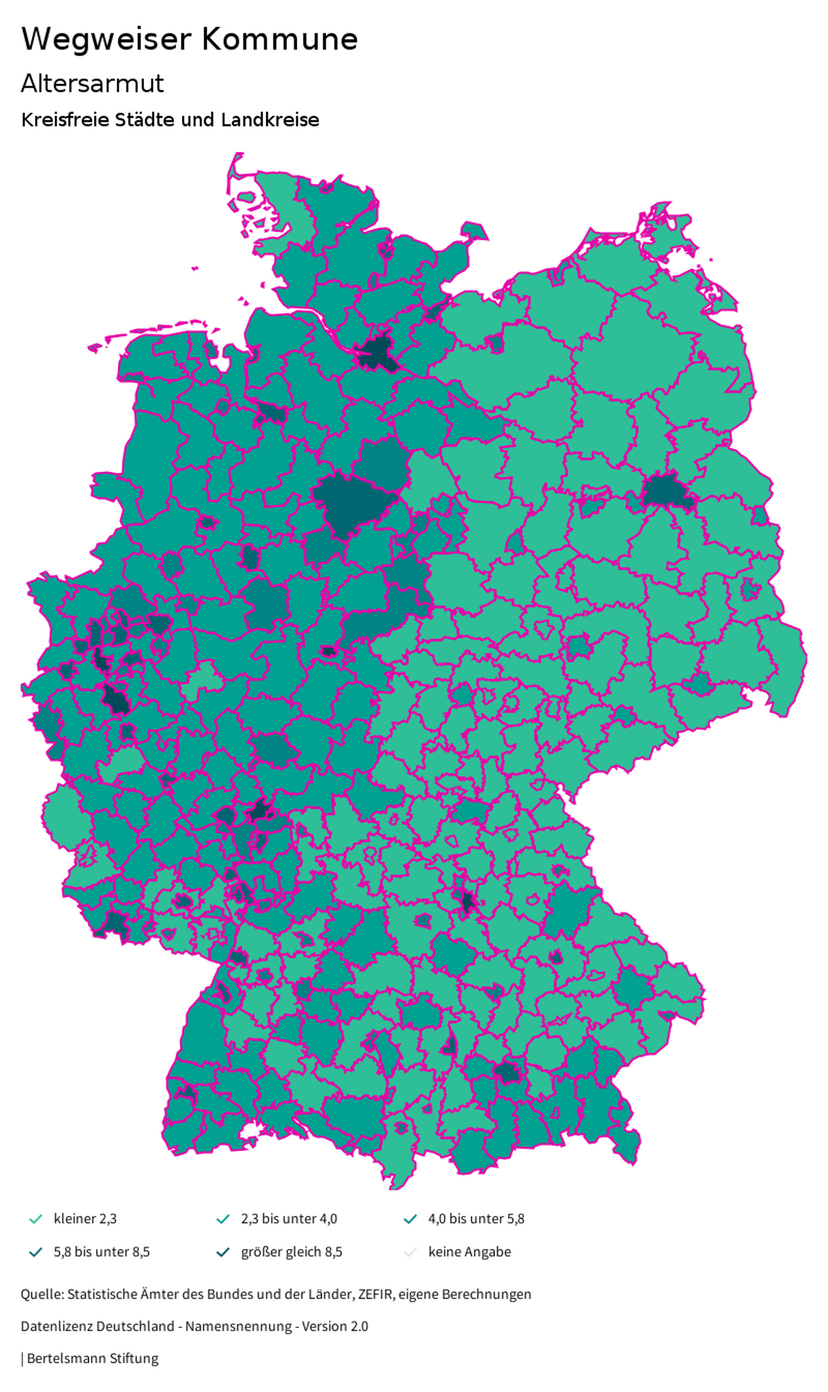
A look at Germany’s cities and counties reinforces this picture. There are 10 counties with rates of less than 1 percent, all of which are located in Thuringia or Saxony. In eastern Germany, the independent city (kreisfreie Stadt) with the highest rate of old-age poverty is Leipzig, at 3.6 percent. Of the 400 counties and independent cities in Germany, 107 have a higher rate than Leipzig – and all are located in western Germany. The highest figure, 10.5 percent, can be found in Offenbach am Main.
Bertelsmann Stiftung
Data from the Community Roadmap portal can be used to carry out analyses of this type for all of Germany’s municipalities with at least 5,000 inhabitants. Anyone interested in knowing how a specific town or city has developed only needs to take a look at the data.
Have fun browsing the portal at www.wegweiser-kommune.de.
![[Translate to English:] Landschaft](/fileadmin/files/_processed_/9/0/csm_AdobeStock_252046738_KONZERN_ST-CC_bearb_Original_96691_abf5b7c75d.jpg "AdobeStock_252046738_KONZERN_ST-CC_bearb.jpg")
![[Translate to English:] Ein Landwirt steht in einem Feld und hält ein Tablet in der Hand](/fileadmin/files/_processed_/4/b/csm_AdobeStock_274990218_KONZERN_ST-LK_Original_97477_c1986149e9.jpeg "AdobeStock_274990218_KONZERN_ST-LK.jpeg")