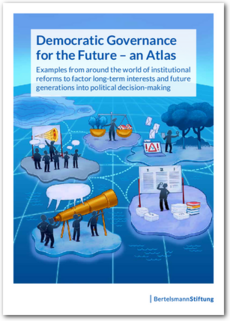

This is the question addressed by the new atlas “Democratic Governance for the Future”. It presents international examples of institutional reforms through which democracies seek to counteract the structural short-sightedness of democratic systems and strengthen long-term perspectives in political decision-making processes.
The examples range from the Parliamentary Committee for the Future in Finland and the Future Generations Commissioner for Wales to the Ombudsman for Future Generations in Hungary. They are complemented by case studies on Israel and Malta. The reforms differ considerably in their mandates, institutional anchoring and impact. Some are regarded internationally as models, while others were abolished again or fell short of expectations. It is precisely this mixture of successful approaches and challenging experiences that makes them so instructive for the debate on the future viability of democracy.
The atlas brings together international experiences, makes different institutional approaches comparable and offers orientation for the discussion on how long-term perspectives can be strengthened institutionally. The examples show that democracies can find ways to create structures that give greater weight to the future. At the same time, they provide insights into the conditions under which such reforms can endure and have an impact.