

gezeichnetes Bild mit Händen, die Gebäude etc. verschieben

Democracy needs a future

Democracy is often assessed in terms of its performance today. However, our policy brief shows that people’s views of the future also shape how they experience democracy. Those who expect future generations to be worse off are significantly more likely to be dissatisfied with how democracy functions. Expectations about the future are therefore closely linked to how people evaluate democracy and emerge as an important source of democratic legitimacy.


Contact persons

Foto Regina von Görtz
Dr. Regina von Görtz
Director
Foto Jonathan M. Hoffmann
Dr. Jonathan M. Hoffmann
Senior Project Manager

Content

Public debate about democracy often focuses on current crises, economic developments, or trust in institutions. Less attention is paid to another precondition for democratic stability: the expectation that society can develop for the better.

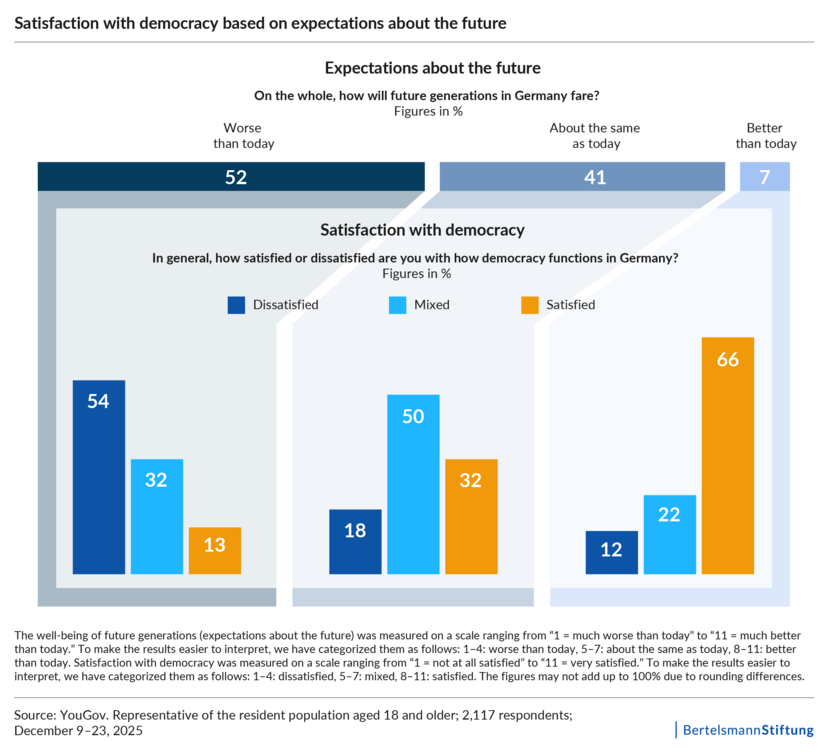
Our representative survey shows that many people in Germany do not share this expectation. More than half believe that future generations will be worse off than people are today. Only seven percent expect future generations to be better off.

This pessimism about the future is closely linked to political attitudes. People with optimistic expectations about the future evaluate the functioning of democracy much more positively than those with pessimistic expectations, even after controlling for other factors. At the same time, they are more likely to support parties close to the political center.
The findings point to a double challenge. On the one hand, many people lack a positive vision of how society might develop going forward. On the other, politics is often perceived as being insufficiently oriented toward the long term. As a result, the future appears less as an open space of possibilities that can be shaped, and more as a risk that has to be managed.

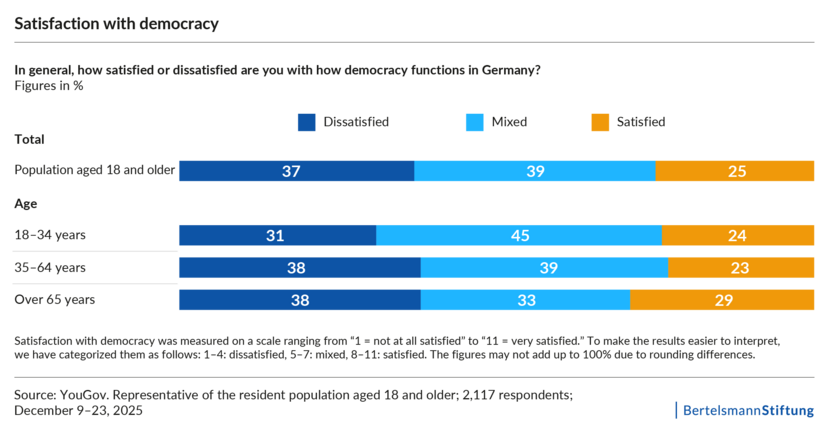
A differentiated look at age groups shows that young people are noticeably more optimistic about society’s future than older generations. They are also less likely to be dissatisfied with democracy and more likely to support giving greater consideration to the needs of future generations in political decision-making. Young people therefore emerge as important allies of a future-oriented democracy. This makes it all the more important to incorporate their perspectives and visions of the future more strongly into political decision-making processes.

Democracy needs more than viable responses to current problems. It needs political visions of the future that provide orientation and make society’s future tangible again as something that can be shaped. After all, how people view the future already shapes how they view democracy today.

Publications