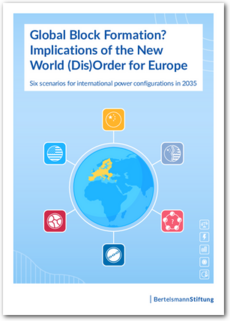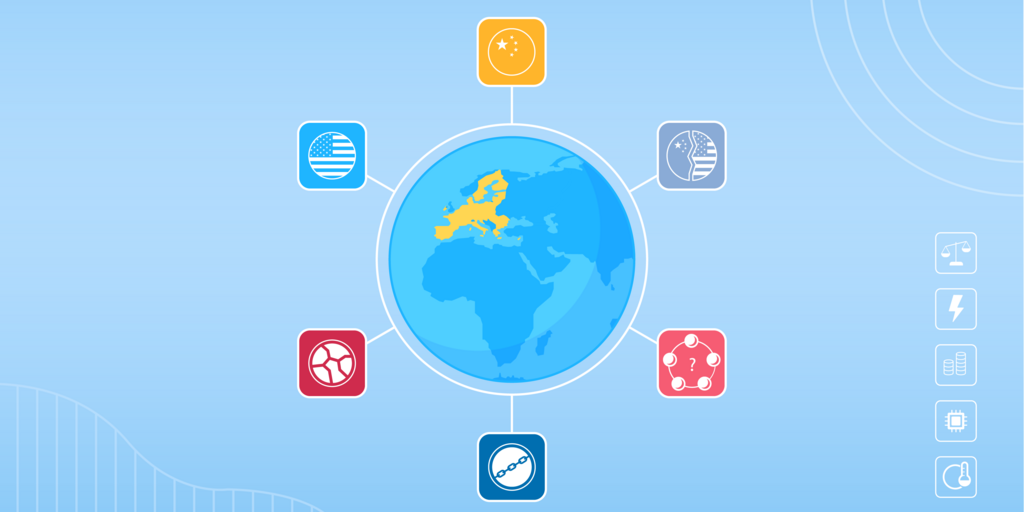


Stylized globe on a light blue background highlights Europe in yellow, surrounded by symbols representing global powers, dependencies, and uncertainties.

Six scenarios for international power configurations in 2035: Implications of the new world (dis)order for Europe

The world order is changing, with the outcome uncertain. What power configuration could the EU face internationally in 2035, and how can it prepare for this? In today’s uncertain and complex world, it is of great strategic importance for decision-makers to prepare for different futures. In a scenario process with the Fraunhofer Institute for Systems and Innovation Research ISI and German experts from business, academia and politics, we have therefore mapped out six scenarios for the world (dis)order in 2035.

Contact

Foto Cora Francisca Jungbluth
Cora Francisca Jungbluth
Foto Anika Sina Laudien
Anika Sina Laudien

Content

China’s rise, the Unites States’ withdrawal, Russia’s attack – the world order is changing. Weakened multilateral institutions and increasing domestic political polarisation are shaping the international landscape. The world order has not only become more unstable, but also structurally more volatile. One thing is clear: There will be no return to the liberal, US-dominated post-Cold War order (for the time being). It is unclear what new (dis)order will emerge over the next decade and what this will mean for the EU. 

We therefore developed six scenarios for the world (dis)order in 2035, which differ in the number of power centres and the degree of stability (see figure). We also identified four fields of action for Europe applicable to all scenarios. If the EU takes consistent, collective and, above all, immediate action in these areas, this will best prepare the EU to assert itself as an, at least partially, independent actor capable of taking action in different international configurations by 2035. 

The scenarios should not be taken as concrete forecasts or predictions. Rather, they aim to serve as a strategic tool for decision-makers, and anyone concerned with the world of tomorrow, to explore different possible futures and sound out their own scope for action. 
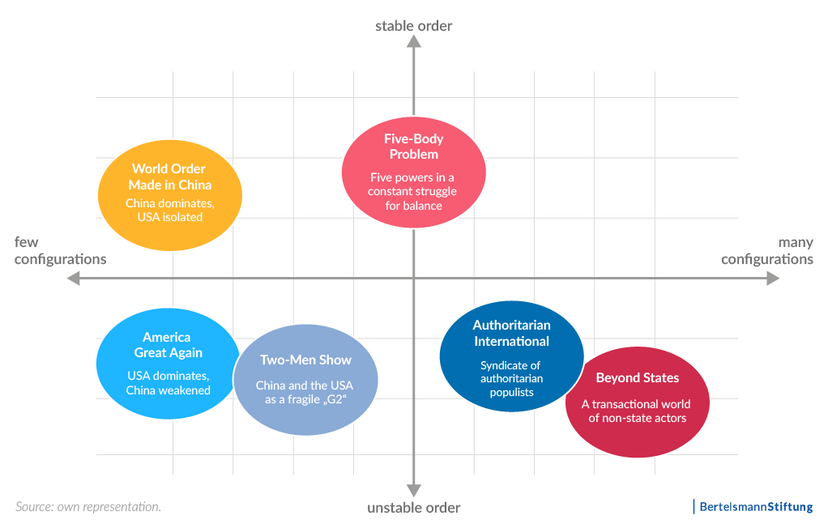
Six scenarios for a world (dis)order in 2035

World Order Made in China
China dominates the global order in a Sinocentric system with reformed international institutions that function according to Chinese rules.  

America Great Again
Following China’s economic collapse, the global order is once again unipolar and is dominated by the autocratic, hegemonic United States, which asserts its interests unilaterally and often in erratic ways.  

Two-Men Show
The bipolar world order has become a reality: China and the United States dominate as fragile “G2” powers, relying on informal deals and personal power balances.  

Five-Body Problem 
Five centres of power – the United States, China, Russia, India and the EU* – keep each other in check and maintain balance through an exclusive security council, the “W5”.  

Authoritarian International 
A global network of illiberal and autocratic governments has displaced the liberal world order. It is replaced by an authoritarian-populist power structure based on personal diplomacy and ideological proximity.  

Beyond States 
The global order has dissolved into a chaotic network of non-state actors, while state authority is waning.

Four fields of action for the EU

The EU can prepare itself to the best of its ability for various scenarios over the next ten years by taking consistent, collective and, above all, immediate action in four fields: 

  1. Effective decision-making: The EU should break down decision-making deadlocks by making strategic use of minilateral formats and underpinning them with a shared set of values. At the same time, it should expand partnerships with (like-minded) third countries in order to increase the EU’s international influence. 

  2. Credible deterrence: Europe should strengthen its defence capabilities through closer integration of national armed forces, joint procurement and innovation structures, and better coordinated investment – in close coordination with NATO. 

  3. Strategic resilience: The EU should prioritise critical key industries and technologies and create targeted strategic indispensability by establishing technological ecosystems and positioning itself in selected market and technology niches. 

  4. Social sustainability: EU institutions and Member States should strengthen social cohesion through credible narratives for the future that legitimise reforms and provide guidance, even in difficult transition phases. 

Inaction will have consequences: The EU could break apart, be worn down or simply become irrelevant as a geopolitical actor. 


* The Five-Body Problem was inspired by the concept of “pentarchy,” coined in 2023 by the German political scientist Herfried Münkler. The title of this scenario is a homage to the science fiction trilogy The Three-Body Problem by Liu Cixin.

Study and Policy Brief