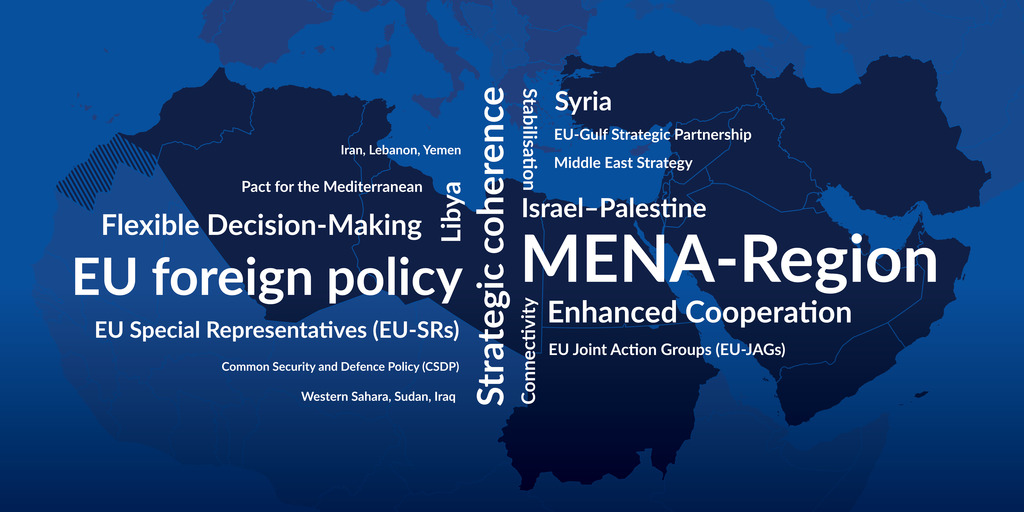

This policy brief highlights the extent to which the EU has developed strategic objectives in its southern neighbourhood, including through the New Agenda for the Mediterranean, the EU-Gulf Strategy (2022), the recently adopted Pact for the Mediterranean, and the renewed vision for the Union for the Mediterranean (UfM). At the same time, these ambitions face a challenging environment marked by persistent conflicts, geopolitical rivalries, and humanitarian crises, which hinder investment and connectivity while further exacerbating internal divisions within the EU.
The analysis centres on the question of why member states, despite often sharing similar objectives, diverge in their choice of instruments and priorities. It draws on an EU-MENA Survey—a consultation of 27 experts from all EU member states—which reveals a spectrum of national perspectives, ranging from humanitarian and normative approaches to security-focused deterrence strategies and migration-driven policy frameworks.
Building on this, the policy brief examines, through case studies of the ongoing conflicts in Israel–Palestine, Syria, and Libya, how fragmentation shapes EU policy towards the MENA region and where untapped potential for more effective European action remains. Given that treaty reform or the introduction of qualified majority voting (QMV) is politically unlikely in the short term, the brief focuses on enhancing flexibility within the existing EU legal framework.
The policy brief concludes with concrete recommendations on how the EU can strengthen its foreign policy impact also in the short term:
- by reinforcing and systematizing the role of EU Special Representatives (EUSRs) in representing / supporting the High Representative (HR/VP) in specific conflict settings;
- by making more consistent use of Common Foreign and Security Policy (CFSP) missions as operational instruments;
- by strategically bundling economic and connectivity initiatives, including within the frameworks of Global Gateway, Team Europe, the EU-Gulf Partnership, and the platforms of the Pact for the Mediterranean and the Union for the Mediterranean (UfM);
- by adopting more flexible decision-making formats, whereby small groups of member states form coordinated EU Joint Action Groups (EU-JAGs) to overcome deadlocks without undermining overall EU coherence;
- by strengthening cooperation with key partners such as the United Kingdom, the Gulf Cooperation Council (GCC), Türkiye, the United States, and NATO in order to enhance the effectiveness of EU external action.