In Germany, a majority of the population continues to favour ambitious measures to protect the climate and the transitions underway in the energy, transport, and heating sectors. 54 percent wish to see increased government investment in climate protection, and approximately 56 percent support further measures within the energy, transport, and heating transitions. However, overall concern about climate change has decreased, and support for various aspects of the sustainability transformation is becoming increasingly fragile. The energy transition exemplifies this trend, with support dropping from 69 percent five years ago and 65 percent three years ago to just 60 percent today.
![[Translate to English:] Verschiedene Personen stecken ihre Hände in die Höhe und halten jeweils einen Gegenstand in der Hand, der für Klimaschutz beziehungsweise die Energiewende steht: Windräder, eine Miniatur-Erdkugel, eine LED-Leuchte sowie eine Energiesparlampe.](/fileadmin/canto/_processed_/c/b/csm_AdobeStock_199513200_KONZERN_ST-W_3b216feb1f.jpeg)
Rawpixel Ltd.
Majority Still Favours Ambitious Climate Protection, but Support is Waning
80 percent of people in Germany are concerned about climate change. 54 percent wish to see more government spending on climate protection, and 56 percent support further measures for the energy, transport, and heating transitions. These findings are the result of this year's survey by the Social Sustainability Barometer of Transformation, a joint project of our foundation and the Research Institute for Sustainability at the GFZ (RIFS). However, comparisons with previous years reveal that public support has declined slightly. Possible reasons for this include the current economic situation and increasing financial burdens, as well as diminishing trust in the government's ability to implement effective policies.

Anne
Meisiek
Project Manager

Luisa Maria
Schulze Marquarding
Project Manager
Content
Concerns over the impact of climate policy on household finances
A key driver of this weakening support is the public’s perception of the economic situation. There is significant concern regarding personal financial impacts over the next five years (53 percent), while 39 percent of the population fear a broad economic decline in prosperity resulting from current climate policies.
Seventy-nine percent of respondents consider the transition to climate-friendly household technologies unfeasible without government support. Among those for whom a climate-neutral heating system, such as a heat pump, is not an option, 41 percent cite financial constraints as the main obstacle; for energy-efficient building renovations, this figure rises to 52 percent. Furthermore, 26 percent see no feasible way to transition to more environmentally friendly transport in the future.
“Acceptance of climate protection measures depends on citizens perceiving them as practically implementable, economically sensible, and fair. In light of this, we need climate policy that offers affordable alternatives, reliable infrastructure, and security of supply, while providing targeted incentives and a fair distribution of burdens,” says Anne Meisiek, one of the study’s authors at our foundation.
For the majority of respondents, economic growth and climate protection are not mutually exclusive; 52 percent value both as relatively equal goals. 44 percent view investment in climate protection as an economic opportunity – nearly twice the number of those who do not yet recognize this connection (23 percent).
“Justified concerns over economic disadvantages and personal burdens provide a gateway for political narratives that seek to obstruct ambitious climate policy. However, those who portray the transformation as a scapegoat for economic concerns are not only missing an opportunity, they are reinforcing doubts about a change aimed at ensuring future viability,” warns Jean-Henri Huttarsch, study author at RIFS.
Low trust in the federal government's climate policy
Beyond feared economic burdens, the inability to effectively communicate climate policy has emerged as a significant obstacle. For instance, 56 percent of the population state that energy transition policy tends to be incomprehensible, and 63 percent feel it is disconnected from the concerns of citizens. Consequently, trust in the federal government's approach to climate policy is low; 55 percent of respondents state that they lack confidence that the government is acting in the public interest when shaping the sustainability transition.
“While public approval of climate protection goals is a necessary starting point, it is not sufficient to guarantee a successful transformation. Long-term, viable climate protection is contingent upon political decisions being grounded in science and the inclusion of citizens through credible engagement. Failing this, even an existing societal mandate for climate protection may be undermined,” summarizes Benita Ebersbach, study author at RIFS.
This is exemplified by the Special Fund for Infrastructure and Climate Neutrality (Sondervermögen Infrastruktur und Klimaneutralität): approximately 85 percent of the population feel poorly informed about this investment programme. Those who feel insufficiently informed, or who have little trust in the federal government, tend to view the fund’s political goals more critically.
“Especially with complex initiatives such as the investment of special funds, it is not enough to simply communicate goals and measures. What is crucial is the trust that the funds are being used transparently, appropriately, and effectively. Reliability and transparency form the essential foundation for this,” says Luisa Schulze Marquarding, study author at our foundation.
Scepticism, not fundamental opposition
The positive finding is that the decline in support observed in recent years does not signify fundamental opposition to climate action. Seventy-eight percent of respondents support an increased share of renewable energies in electricity generation, and a majority also favour an expansion of local wind energy. Approximately one-third of those currently opposed to wind turbines could be persuaded if provided with the opportunity for financial participation in the returns from wind power. Furthermore, a clear majority of around 59 percent believe that investment in climate protection must happen now to reduce costs in the long term.

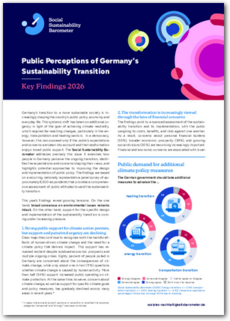
The Social Sustainability Barometer of Transformation is a joint project of our foundation and the Research Institute for Sustainability at GFZ (RIFS). Building on previous iterations conducted between 2021–2023, it is designed as a panel study, meaning the same individuals are surveyed repeatedly regarding their attitudes, concerns, and expectations concerning the socio-ecological transformation. The survey is conducted by forsa via the forsa.omninet panel. The target population for the current study consists of the German-speaking resident population aged 18 and over in the Federal Republic of Germany. For this year's online survey, 6,566 people were interviewed between 23 March and 13 April 2026.