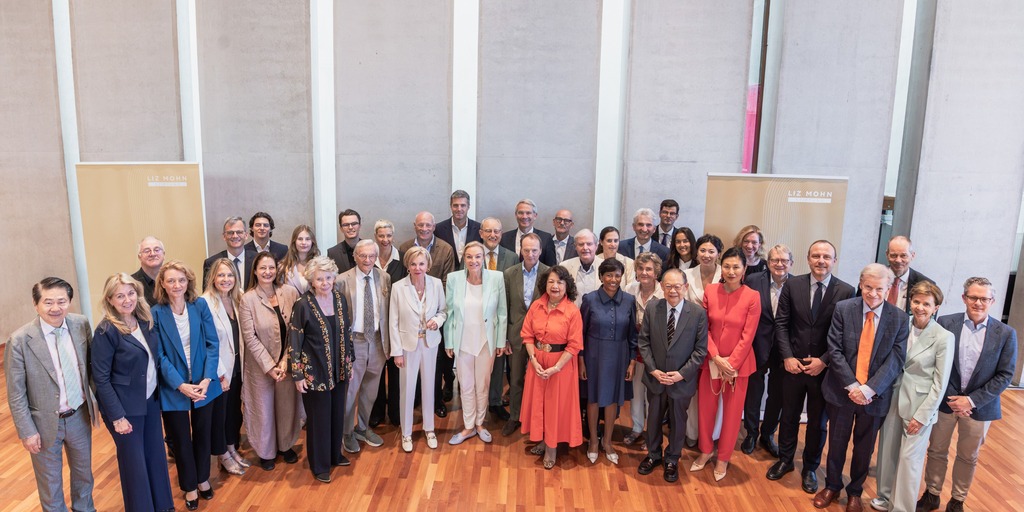
The initiators of the “Salzburg Trilogue,” former Austrian Chancellor Wolfgang Schüssel and Liz Mohn, founder and chair of the board of the Liz Mohn Foundation (front row, 7th and 8th from the left), with the conference participants.

25th Trilogue Salzburg: Good Leadership Requires Strong Values, Trust, and the Ability to Adapt

International dialogue forum explores "Leadership in Turbulent Times": Sound judgment, cultural intelligence, and trust are becoming essential leadership skills

Contact Person

Foto Jochen Arntz
Jochen Arntz
Vice President Media Relations

Content

How can leaders provide direction when familiar assumptions no longer hold, technological developments are changing the way decisions are made, and international cooperation is becoming more difficult? Leading figures from politics, business, and culture explored this question during the 25th Trilogue Salzburg. At the invitation of founder Liz Mohn and former Austrian Chancellor Wolfgang Schüssel, they gathered in Salzburg on August 23 and 24 to discuss "Leadership in Turbulent Times."

The discussions showed that the demands placed on leaders are changing fundamentally. In a world shaped by geopolitical shifts, technological disruption, and social polarization, leadership is not primarily about having a ready answer to every development. What matters instead is being able to make sense of complexity, remain capable of action even in uncertain conditions, and actively shape change. Leaders must keep long-term goals in sight while remaining prepared to adjust how they pursue them as circumstances change.

"For me, leadership begins with strong values. Anyone who assumes responsibility must know what they stand for and the direction their leadership will take. Good leadership means listening to people, providing direction, and engaging them in the process of change. It requires the courage to make decisions and trust – both in people’s abilities and in the process itself. In a complex world, no one person can have all the answers. That makes it all the more important to share responsibility, empower others, and work together to develop viable solutions," said Liz Mohn, founder and Chairwoman of the Executive Board of the Liz Mohn Foundation.


Technology is changing leadership

One focus of the discussions was the impact of digitalization and artificial intelligence. These technologies make it easier to process vast amounts of information, but they are also changing how we perceive information and make decisions. Leaders must therefore continue to assess information critically, consider different sources, and exercise sound judgment. The impact of artificial intelligence on the work of leaders is particularly significant, as several recent studies by the Liz Mohn Foundation have also shown.

Cultural intelligence is becoming a key leadership skill

Although competition between nations is intensifying, this does not mean that globalization is coming to an end. Instead, international relations are being reshaped and becoming more diverse. In a multipolar and multilateral world, leaders must take into account the political, economic, and cultural differences found in other countries. Especially in a world where shared challenges increasingly demand cross-border cooperation, the ability to build trust across cultural and political differences is becoming essential to successful leadership.

Leadership begins with taking responsibility

Leadership is not limited to senior positions in politics, business, or culture. It is evident wherever people take responsibility for others and for collaboration between them – in the workplace, in volunteer activities, in schools, and in everyday life. In the face of global phenomena such as social media, fake news, information overload, and growing polarization, leadership is, above all, about providing direction, incorporating different perspectives, and building trust. "We are not helpless in the face of the times we live in. Both in our immediate surroundings and on a larger scale, we can make a difference, support others, and help change the world for the better," emphasized Wolfgang Schüssel.

This broader understanding of leadership was also reflected in the composition of the Trilogue Salzburg: Once again, young people joined seasoned experts from around the world, bringing their questions, expectations, and ideas to the discussions. The 25th Trilogue Salzburg thus underscored a key insight that goes beyond individual leadership models: In a world whose future course is becoming increasingly difficult to predict, direction does not come from simple answers. It comes from strong values and a willingness to take responsibility, from the ability to learn and involve others, and from trust.

Now in its 25th edition, the Trilogue Salzburg brings together leading figures from politics, business, and culture to address key questions about the future – from peace and international cooperation to Europe’s competitiveness and the role of culture in strengthening social cohesion.