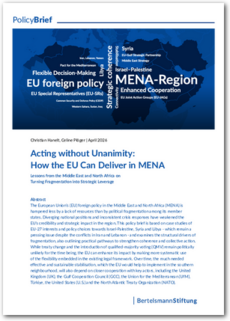
The EU’s ability to deliver vis-à-vis their southern neighbours in the Middle East and North Africa (MENA) is not only a question of having the right instruments, but also of political cohesion among EU Member States.
As crises persist and geopolitical competition intensifies, as the Iran War and its consequences demonstrate, the decisive obstacles increasingly lie within the EU itself: foreign-policy decisions often remain constrained by unanimity, enabling dilution or blockage of common action and undermining the EU’s credibility and impact.
This policy brief examines the specific areas in which, and the reasons why, EU Member States differ in their approaches to the MENA region, illustrating this with an overview of the 10 MENA crises, from Western Sahara to Iran. The implications of these differences are particularly evident in the three prominent conflict cases of Israel–Palestine, Syria and Libya; the policy brief thus demonstrates which political options can help to transform this disagreement into strategic influence and enable the EU to act more effectively even without unanimity.
This publication is a revised version and is available for download with a new DOI.