While the EU remains the most interconnected actor, its dominance is being challenged, particularly by China. To strengthen its position, the EU must use its single market, regulatory power and financial capacity, ensuring neighbours see clear benefits in aligning with Europe.
A New Perspective on Europe’s Neighbourhood
After the Cold War, many believed law, markets and soft power would govern international relations, with interdependence securing peace. The EU invested in trade, integration and regulatory alignment, confident prosperity and stability would reinforce one another.
That vision has faded. Economic ties are now instruments of competition and coercion. Access to markets, energy or technology is used for political leverage. The line between economics and power has blurred.
Europe’s neighbourhood—from the Western Balkans and Eastern Partnership states to Türkiye and the Southern Mediterranean—has become a contested arena where the EU, China, Russia and, to a lesser extent, the US seek influence. Until now, there was no systematic way to measure these rivalries.
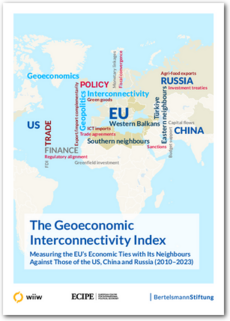
The GEOII fills this gap. Based on 43 indicators across trade, finance and policy, and covering 2010–2023, it offers a comprehensive assessment of interconnections and their evolution.
Why Geoeconomic Interconnectivity Matters
The EU’s role as the central partner in its neighbourhood can no longer be taken for granted. China has expanded through infrastructure, investment and trade. Russia, though in decline, still exerts influence through energy and food exports, as well as coercive tactics. The US has long played a limited economic role, which has further receded.
Many countries now navigate competing offers and pressures. The GEOII serves as a data-driven tool for analysis and strategy, showing where the EU is strong, where it is losing ground, and where it must adapt.
Key Findings from 2010 to 2023
1. The EU remains the most interconnected actor
Across all neighbourhoods, the EU continues to lead. Its position rests on trade volumes, investment flows, financial integration and agreements. Enlargement, association treaties and regulatory alignment add depth.
2. Since 2021, the EU has lost ground in some areas
The data show a turning point. The EU’s dominance is intact overall, but it is losing relative strength in high-technology trade and investment.
3. China is catching up
China has systematically expanded its footprint, overtaking the EU in some categories. Its strategy combines infrastructure financing, technology transfer and closer diplomatic ties.
4. Russia continues to exert leverage
Despite sanctions and economic decline, Russia still wields power through energy and agri-food exports, using them as political tools, especially in Eastern Europe.
5. The United States plays only a limited role
The US has never been deeply integrated economically in the region. Since 2017, its interconnectivity has declined further, leaving the field mainly to the EU, China and Russia.
Taken together, these findings show Europe as the dominant but increasingly challenged actor. Rival powers are active, and in some areas advancing quickly.
What It Means for Europe
The GEOII highlights the EU’s challenge in reconciling its identity as a community of rules and cooperation with the realities of geoeconomics, where connectivity is about power as much as mutual benefit.
The EU retains major strengths—its single market, regulatory weight and financial capacity. But it is vulnerable in high-technology trade, investment and strategic sectors, where others are advancing. Against Russia’s coercion and hybrid tactics, Europe has often struggled to respond effectively.
The lesson is clear: connectivity must be used strategically. The EU must mobilise its economic weight more decisively, deepen partnerships, and ensure neighbours see tangible benefits from alignment with Europe rather than rivals.
Explore the GEOII
Interactive graphics, full results and regional breakdowns are available at geoii.eu, also linked through this website’s menu.
How the Index Works
The GEOII follows OECD and EU Joint Research Centre standards. It measures 43 indicators annually from 2010–2023, grouped into three sub-indices:
- Trade: imports, exports, high-tech goods, energy flows
- Finance: foreign direct investment, banking, development finance
- Policy: treaties, agreements, regulatory alignment, arms transfers, political engagement
Each region—Western Balkans, Eastern neighbours, Türkiye and Southern Mediterranean—is assessed separately, with results aggregated to give an overall picture.
The GEOII does not reduce relationships to a single score. Instead, it captures multiple dimensions of connectivity—how leverage and influence operate in practice. Over time, it will help track patterns, turning points and the impact of events such as the war in Ukraine, new trade deals or investment shifts.