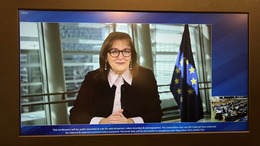
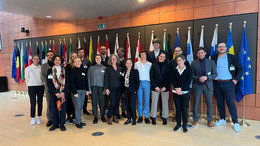
The highlight on the second day was a public evening event titled “Citizen Participation in Troubled Times: Ensuring Impact through Quality.” The high-level panel brought together key political stakeholders from various European contexts.
At the heart of the discussions was how citizen participation can be designed not only well but also politically binding and institutionally anchored in politically and socially challenging times.
Guidelines as a Foundation for Political Impact
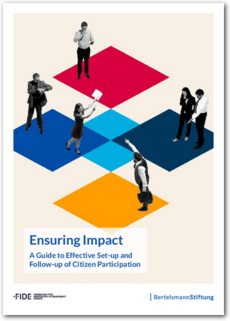
At the start of the event, Angela Jain, participation expert at the Bertelsmann Stiftung, presented the network’s new guidelines for effective citizen participation, providing the substantive impetus for the discussion. She emphasised:
“The participation process does not end with the production of the citizen report. The subsequent implementation and follow-up process is at least as important to ensure that recommendations actually have an impact.”
The guidelines outline key quality principles – from clear goal setting and transparent communication to institutional linkage with political decision-making. Especially in “troubled times,” this connectivity determines whether participation strengthens legitimacy or remains without consequence.
High-Level Discussion on More Courage for Power-Sharing
Panel participants included:
- Barbara Bosch, state councilor for Civil Society and Citizen Participation of the State of Baden-Württemberg
- Stephen De Ron, Rapporteur for the Democracy Shield opinion in the European Committee of the Regions
- Magali Plovie, former President of the French-speaking Parliament of the Brussels-Capital Region and initiator of permanent deliberative committees
- Prof. Dr. Yves Sintomer, Professor of Political Science at the University of Paris 8
Moderated by Dominik Hierlemann, Senior Advisor at the Bertelsmann Stiftung, the discussion was both high-profile and self-critical. Key insights included:
- Democratic resilience needs binding participation standards,
- Quality and follow-up determine legitimacy,
- There is a need for more courage to adopt more direct, power-sharing participation formats.
The public evening event marked an important step towards strengthened political advocacy for more binding, institutionally anchored citizen participation at both national and European levels. With the new guidelines, a practice-oriented reference framework is now available.
Ensuring Impact – A Guide to Effective Set-Up and Follow-Up of Citizen Participation
Our guidelines “Ensuring Impact – A Guide to Effective Set-Up and Follow-Up of Citizen Participation” are available here in English for download.