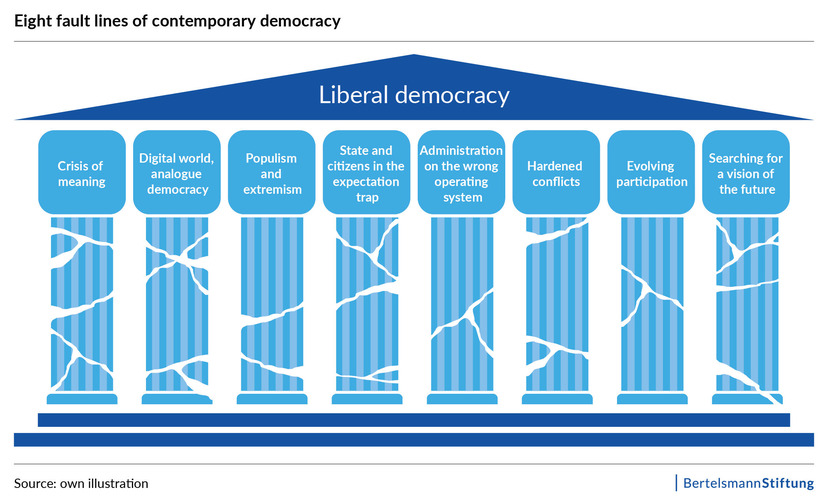
This policy brief examines eight fault lines shaping liberal democracy – from the crisis of meaning, to digital-analogue divides and entrenched conflicts, to the search for a vision of the future. Democracy is in transition along these lines, exploring its way forward. The policy brief highlights potential directions for renewal.
![[Translate to English:] Blume](/fileadmin/files/_processed_/f/7/csm_AdobeStock_1429358700_KONZERN_DZ_KI-GENERIERT_01_840b9f5ee5.jpg)
Volha - stock.adobe.com / KI-generiert
Fault lines in democracy – Towards a new culture of conflict and participation in the age of AI
Democracy once had it easier. Its global influence is declining, social conflicts are hardening, and trust in state institutions is eroding. Yet citizens are demanding more participation and a stronger sense of belonging. How can democracy respond? To renew democracy, we must address the defining fault lines of our time. In the age of AI, government and society need to cultivate openness towards more cooperation and a new culture of conflict and genuine compromise.

Dr.
Dominik
Hierlemann
Senior Advisor

Rebekka
Vollmer
Project Manager

Dr.
Stefan
Roch
Project Manager

Dr.
Angela
Jain
Senior Project Manager
Content
Bertelsmann Stiftung
What can we expect from democracy in the age of AI? How can citizen participation drive political progress? How can understanding and compromise be fostered in a digital society?
We need to cultivate a new culture of constructive debate and compromise: one that acknowledges differences and seeks common ground through dialogue. This requires both digital and analogue spaces where democratic exchange can take place and be actively practiced.