

Kinderkonferenz

Children’s Conferences: “Future Voices: Now It’s Our Turn!”

Contact persons:

Foto Simone Aistermann
Simone Aistermann
Project Manager
Foto Lena Budach
Lena Budach
Project Manager
Foto Ruth Kordtomeikel-Hiller
Ruth Kordtomeikel-Hiller
Project Assistant
Foto Stephanie Swinburne
Stephanie Swinburne
Project Assistant

Content

Children have a right to be heard. Article 12 of the UN Convention on the Rights of the Child requires states to give due consideration to children’s views in all matters that affect them. Participation is therefore not an optional extra, but a fundamental children’s right. 

In practice, however, this right is often not fulfilled — especially for younger children under the age of 14. Their perspectives are rarely gathered in a systematic way, and their concerns often do not feed into political decision-making processes. 

With our peer-to-peer conference format, “Future Voices: Now It’s Our Turn!”, we create spaces where children can express their own perspectives, wishes and needs — and present them directly to decision-makers from politics, schools and public administration. 

As part of the project Growing Up in Well-being, we are expanding this proven conference format through structures and networks in several German states and aim to establish it as a sustainable participation tool in schools and municipalities.

What is a children’s conference?

Our children’s conferences are a low-barrier participation format for children aged 6 to 14, or in grades 1 to 6. 

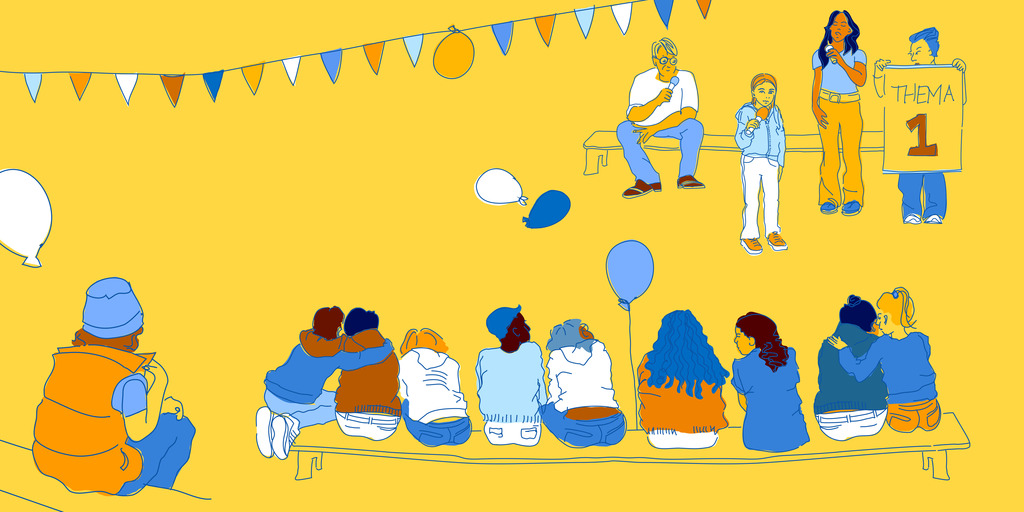
In workshops, children explore topics from their own everyday lives — such as school, leisure, health, children’s rights or their local environment. Young moderators aged 16 and above facilitate the workshops using a peer-to-peer approach and help create an atmosphere of trust and equality. 

At the end of the conference, the children present their ideas and demands together with the youth moderators in a dialogue with invited guests from politics, public administration and civil society. In this way, participation becomes a tangible experience — and political feedback is immediate.

Local impact

Children’s conferences make it possible to: 

  • put children’s rights into practice within local structures,  

  • strengthen all participants’ sense of agency,  

  • enable direct dialogue between young people and decision-makers,  

  • generate concrete ideas for schools and municipalities, and  

  • make children’s needs more visible.  

In the long term, children’s conferences help ensure that the structural participation of younger children becomes the norm and that their perspectives are systematically included in political processes. The conferences are therefore not intended to be one-off events, but part of a broader local participation strategy.