Empowering youth for a sustainable future

Bertelsmann Stiftung (Hrsg.)
Redford, D., Cagarman, K., von Arnim, L., Bürger, T., Weber, J.
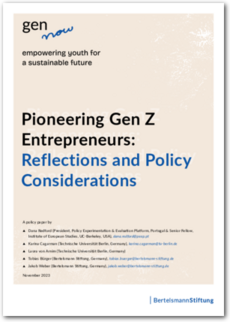
Pioneering Gen Z Entrepreneurs: Reflections and Policy Considerations
- Verkaufshinweise
- Policy Paper
- Ausgabeart
- Erscheinungstermin
- 17.11.2023
- DOI
- 10.11586/2023090
- Auflage
- 1. Auflage
- Umfang/Format
- 28 Seiten, PDF
Format
-
PDF
Preis
kostenlos
Beschreibung
Entrepreneurs change the way we think, work and live. Around the globe, inspiring young people are building successful companies around ideas that are driven by their ambitions and enabled by their entrepreneurial skills and values. Generation Z - referring to people born after 1997 - is reshaping our economies with its distinctive approaches to work and entrepreneurship.
The members of this generation tend to value collaborative and flexible work, and strive to integrate a focus on sustainability into their working lives. For this reason, youth entrepreneurship is an exciting area, as it attracts ambitious young people who want to change the world by engaging in business activities.
As a means of better understanding how to help this generation live up to its potential, this policy paper seeks to identify key drivers and barriers affecting young entrepreneurs committed to sustainability and innovation. To do so, it uses a focused case study centered on the fellows of the Sigma Squared Society, a network of founders under 26 years of age with over 800 members globally. The paper is informed by a quantitative survey of the Society’s members and supplemented with in-depth interviews of six fellows, selected on the basis of their active engagement in innovative sustainable ventures.
One issue of significant concern to these young businesspeople was “regulatory anxiety,” a term used to describe the apprehension felt by young founders as they confront complex legal frameworks. Young founders do not perceive the government as an enabler, but rather as a constraint to successful entrepreneurship. Hence, simplifying and reducing bureaucratic burdens by digitalizing application processes should be a top priority for public policymakers.
Founders under 18 face unique barriers that make it difficult for the youngest entrepreneurs to start businesses. Policymakers can also improve the environment for ambitious young people by providing better access to grants and loans, assisting them in protecting their innovations through copyrights and patents, offering programs that support early entrepreneurial activities in particular, and providing better practical implementation guidance. Most important is practical, hands-on assistance, ideally from other young people who have already succeeded: Gen Z wants to learn from itself through learning by doing.
The highly successful Gen Z entrepreneurs showcased in this study exhibit the kind of resilience and optimism that epitomizes a positive psychology mindset. If fostered widely, this could significantly benefit entrepreneurial culture. Young founders have no trouble revealing their vulnerabilities to colleagues; they pay close attention to their own mental health and consciously practice optimism even in the face of failure. Encouraging and empowering the next generation of sustainable entrepreneurs should be in everyone’s interest.
This policy paper seeks to identify key drivers and barriers affecting young entrepreneurs committed to sustainability and innovation. To do so, it uses a focused case study centered on the fellows of the Sigma Squared Society, a network of founders under 26 years of age with over 800 members globally. The paper is informed by a quantitative survey of the Society’s members and supplemented with in-depth interviews of six fellows, selected on the basis of their active engagement in innovative sustainable ventures.