AI is rapidly becoming part of Europe’s basic infrastructure - supporting search, communication, education, healthcare and security-relevant systems. Yet this infrastructure is increasingly developed and governed by a small group of non-European firms that concentrate investment, data and talent. This creates risks for strategic autonomy, democratic decision-making and the European social model.
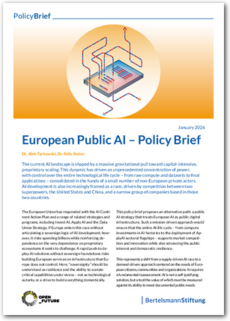
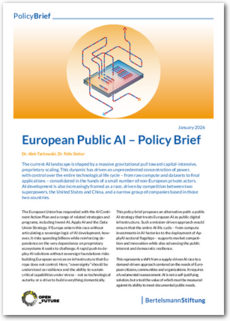
In this policy brief, which we published in cooperation with Open Future, we propose Public AI as an alternative: AI understood as public digital infrastructure organized around the common good.
In the policy brief, we show and argue that:
- Public AI rests on three pillars: universal, equal and nondiscriminatory access to compute, data, models and applications; mission-driven public goals; and meaningful public control.
- Europe’s current initiatives (AI Continent Action Plan, Apply AI, Data Union Strategy) are significant - but without a Public AI focus they may reinforce dependencies.
- Three Public AI policies are essential: prioritizing Public AI objectives in compute investments; building a family of permanently open, democratically governed European public foundation models; and creating a European data commons with Data Labs linking data, developers and compute.
![Project reframe[Tech] - Algorithms for the Common Good](/fileadmin/files/_processed_/a/2/csm_1330212585charlota-blunarova-hmzKFGDeOV4-unsplash_2zu1_final_3324274488.jpg "charlota-blunarova-hmzKFGDeOV4-unsplash_2zu1_final.png")
![Cover reframe[Tech] - Algorithms for the Common Good](/fileadmin/files/_processed_/a/2/csm_1330212585charlota-blunarova-hmzKFGDeOV4-unsplash_2zu1_final_fdf0650ea6.jpg)