

Mobiles, Laptop, Post its

Artificial Intelligence and the Future of Citizen Participation: New Report and Policy Brief published

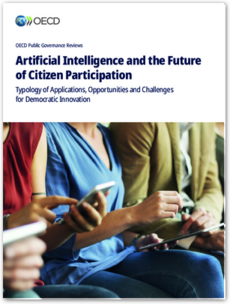
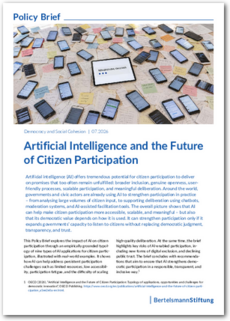
In the report Artificial Intelligence and the Future of Citizen Participation, the OECD and the Bertelsmann Stiftung examine how artificial intelligence can support and improve citizen participation. Based on 50 real-world cases from 22 countries, the study presents nine types of AI applications, assesses their opportunities and risks, and provides recommendations for responsible use. An accompanying Policy Brief offers a concise overview of the key insights.

Foto Dominik Hierlemann
Dr. Dominik Hierlemann
Senior Advisor
Foto Angela Jain
Dr. Angela Jain
Senior Project Manager
Foto Stefan Roch
Dr. Stefan Roch
Project Manager

Content

How AI can strengthen citizen participation

Citizen participation can improve public policy, strengthen political agency and contribute to trust in government. Yet many processes still struggle with limited resources, accessibility barriers, large volumes of citizen input and the challenge of maintaining meaningful dialogue at scale.

Artificial intelligence (AI) can help address some of these obstacles, especially in digital, but also in face-to-face participation processes. Governments and civic actors are already using AI to analyse contributions, translate multilingual input and transcribe content, guide citizens through participation processes, moderate discussions and support facilitation. 

The potential is vast – but AI is not an end. Its use can neither replace the political will to genuinely take citizens’ perspectives into account, nor can it take over democratic decision-making or human responsibility. It is therefore crucial to identify where AI can provide meaningful support for citizen participation and what conditions must be met to ensure its responsible use.
The publications illustrate these applications with examples from around the world and are intended to encourage readers to try them out. In Cambridge, for example, an AI tool reduced the time needed to analyse qualitative consultation input by approximately 50 percent. In Finland, the platform Polis helped map the views of more than 18,000 participants in a nationwide consultation. 

How should risks be handled?

At the same time, the publications highlight substantial risks. Biased data, opaque systems and algorithms, unequal performance across languages, digital exclusion, surveillance, manipulation, and excessive reliance on automated results can undermine inclusion, trust, and the quality of democratic deliberation.

The recommendation is therefore to combine clear guardrails, practical enablers, and meaningful public engagement. Governments should protect rights and civic space, make AI use transparent and contestable, strengthen skills within public administrations, avoid technological lock-ins, maintain non-digital participation options, and involve citizens in shaping and overseeing AI systems.

AI can never be a substitute for citizen participation in a democracy. However, when used responsibly, it can help governments and other organizations give more people a voice, make participation more accessible, and make more effective use of citizens’ contributions in policy-making processes.

What do the publications offer?

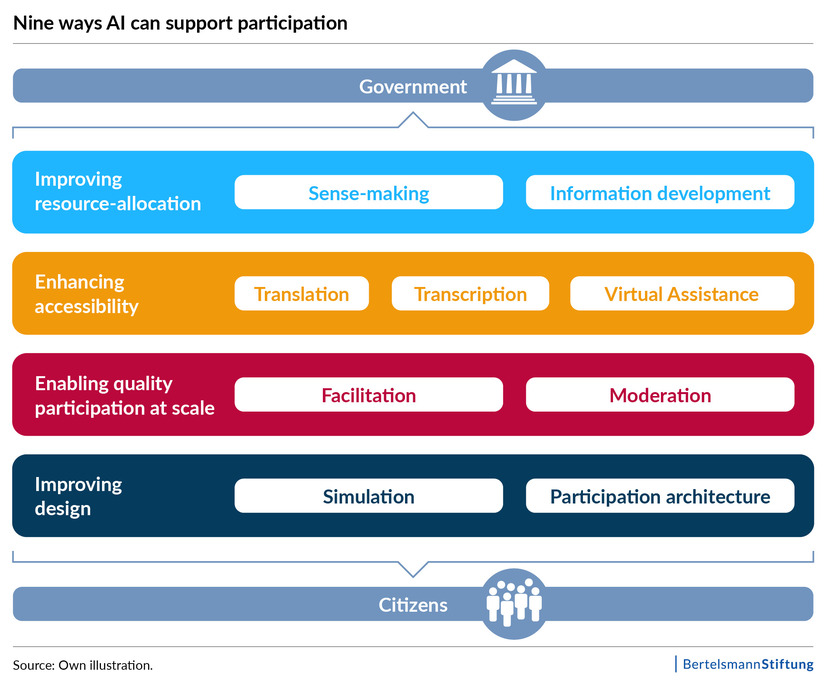
Drawing on existing tools and real-world use cases, the study develops a practice-oriented typology of nine areas of application for AI and demonstrates how these can contribute to four key objectives for their use in citizen participation processes:

• More efficient use of resources through better utilisation of tools for analysis, structuring and information processing,

• increasing accessibility and removing barriers to participation through multilingual support, translation, transcription and virtual assistance,

• facilitating high-quality participation, even on a large scale, through moderation and process support,

• improving participatory processes through simulations and democratically designed participation platforms,

• responsible management of the risks associated with the use of AI.

Developed through an OECD–Bertelsmann Stiftung collaboration

The study was developed in close collaboration between the OECD and the Bertelsmann Stiftung. The accompanying Policy Brief condenses its findings for policymakers and participation practitioners.

Study and Policy Brief 07/2026: Artificial Intelligence and the Future of Citizen Participation