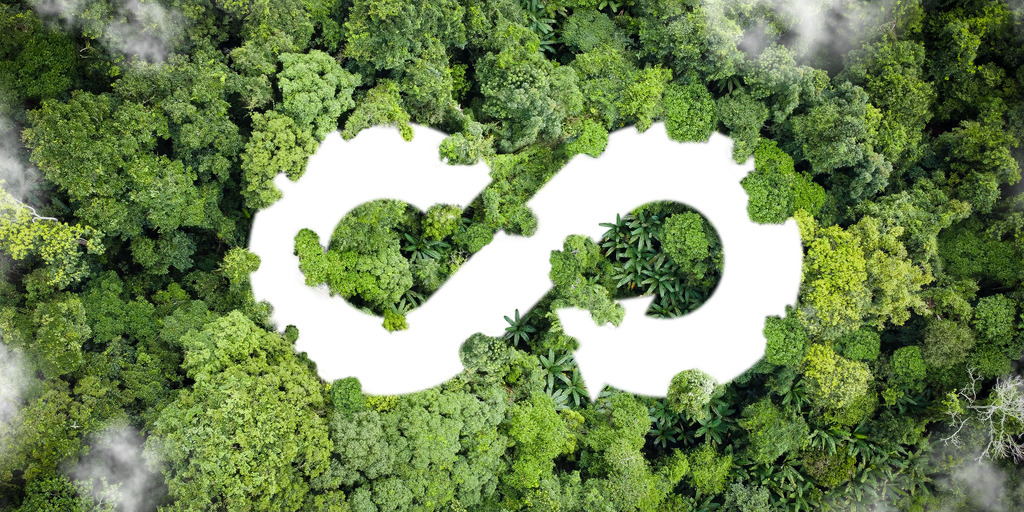
The new federal government in Germany says its goal is an economy – one that is circulating. The strategy for circular economy from the old federal government is to be set in motion. This clarifies the growing politic intention for a transformation to a more than comprehensive understood circular economy. However, politics and support programs are currently still focusing primarily on technological and ecological innovations to pave the way for circular value creation.
Businesses, which aside from circular solutions also have public good-oriented solutions – so-called circular social businesses – receive less attention, recognition and support, even though they offer great potential for economic, environmental and social benefits. These businesses are in focus in the study “A systemic Circular Economy Transition in Germany. The Role and Impact of Circular Social Businesses”, which the Yunus Environment Hub and the Bertelsmann Stiftung presented to the public today.
Out of 274 for this study examined circular startups in Germany, 39% can be called circular social businesses. They fulfill three criteria: (1) a viable business model, (2) a clear environmental contribution through circular strategies such as “reduce”, “reuse” and “regenerate” and (3) a social impact logic that is firmly anchored in the core business. These companies are active in industries such as food, textiles, and packaging and are often locally rooted.
The analysis shows that circular social businesses focus more strongly on innovative strategies like “rethink” and “regenerate”. Such strategies go beyond mere recycling or efficiency improvements and fundamentally change forms of production and consumption. Their solutions promote social integration, cohesion, local value creation, cooperation, educational opportunities and social empowerment. Circular social businesses thus not only reduce resource consumption but also strengthen communities and enable social participation.
Circular social businesses demonstrate that the circular economy can be much more than just a topic concerned with technological solutions – it can also bring with it a more holistic approach to the needs of people and society. To fully exploit the potential of the circular economy, social impact should not be a mere by-product but a central component of corporate and political strategies. By supporting circular social, the transition to a circular economy can be accelerated, which is both environmentally sustainable and socially inclusive, triggering comprehensive change.
The authors of the study, Julia Gschwender and Andrea Naranjo from the Yunus Environment Hub and Armando García Schmidt from the Bertelsmann Stiftung, also formulate recommendations for strengthening circular social businesses in Germany:
- For companies: at least three of the five principles for systematic transition – address causes, change behaviour, enable access, promote cooperation and practice transparency – and consistently align growth with social and environmental goals.
- For sponsors and investors: Consider funding models and strengthen social impact and local relevancy. Specifically promote the scale of successful local solutions with wide use.
- For political decision makers: Social and public-good oriented aspects in circular economy strategies like the NKWS should be prominently anchored. Tailor support programmes to business models that also take the social dimension into account and use public procurement to strengthen demand for sustainable and socially inclusive solutions.