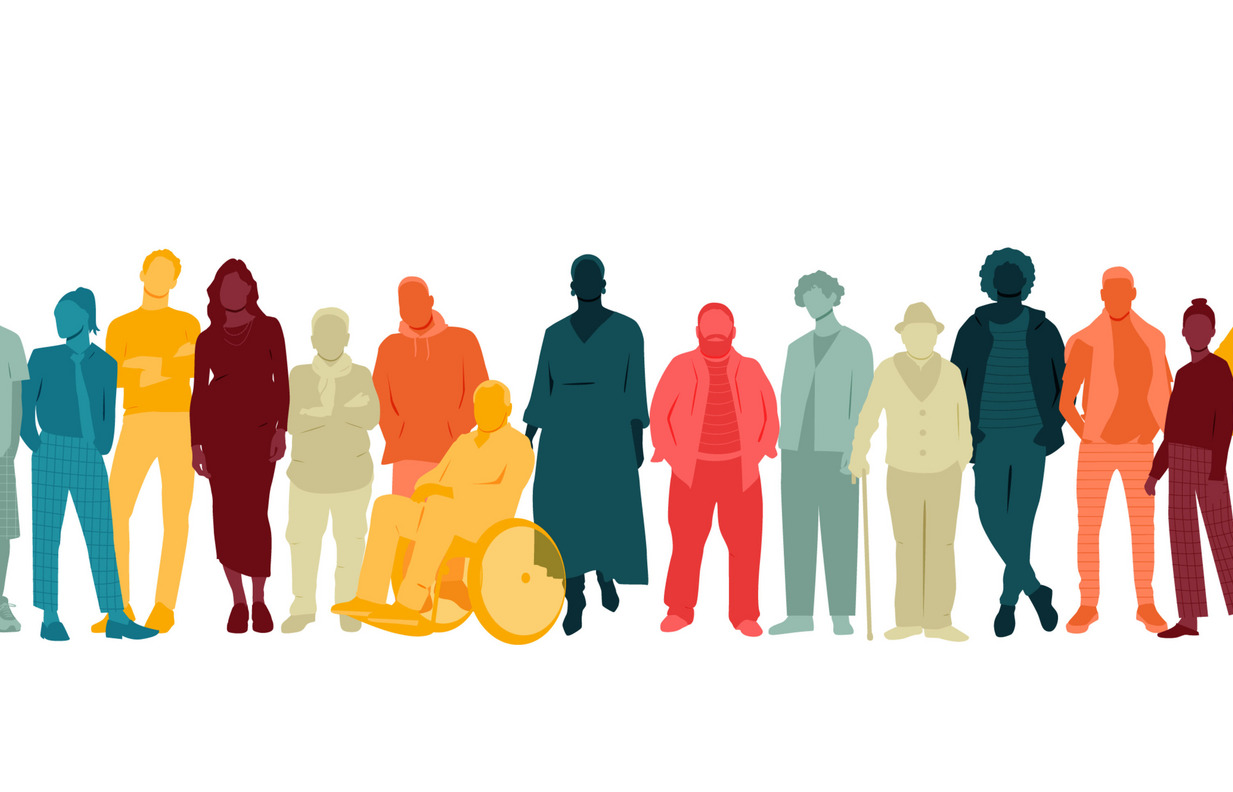
Diverse citizen participation means that not always just the “usual suspects” join. Instead, it enables many different perspectives to influence a participation process. Participation thereby not only strengthens trust but also leads to better outcomes.
That sounds good, but in practice it is not that easy to apply. The new SHORTCUT explains what matters for process organisation and implementation and demonstrates through examples which methods of diverse citizen participation can be successful.
Download the SHORTCUT as PDF here.
English edition
German edition

The more perspectives, the better the participation
Citizen participation is an essential part of an inclusive democracy. It can improve political decision-making by grounding it in the everyday experiences of citizens, strengthen trust in political processes and foster connections between citizens, policymakers and the public administration. Participation is most effective when a broad range of perspectives and experiences are included, which help to clarify problems and identify solutions. The aim of diverse participation is to go beyond the “usual suspects” and involve people from the wider population. It explicitly reaches out to those who have little political interest, lower levels of education, or limited financial means, for example.
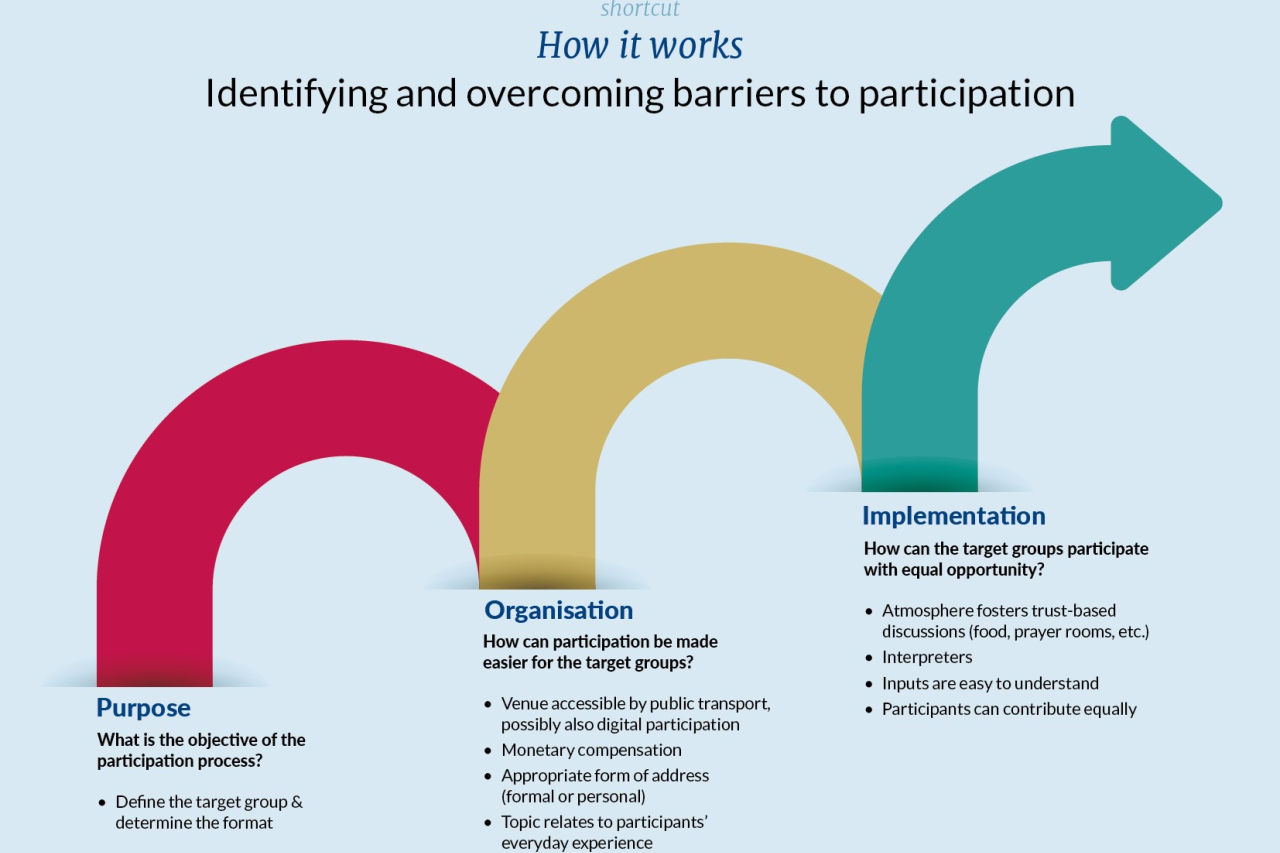
How can diverse participation succeed? Three aspects are key: Firstly, the purpose of the participation process must be clear. Depending on this purpose, the target group and format of participation can be defined. Certain groups may require a protected space to discuss issues such as discrimination. Some issues are particularly relevant to specific groups, such as urban development projects. For other topics, it is beneficial to involve as many different people as possible — for example, in a citizens’ assembly. Secondly, barriers to participation should be identified and overcome. People from groups who rarely or never join participation processes are often prevented from doing
so by external circumstances. Thirdly, a lack of trust or a sense of disempowerment also prevents many people from taking part. Participation is not self-evident for most people, but organisers can address this in the planning process to make participation more diverse.
![[Translate to English:] Ausrufezeichen in pink](/fileadmin/files/Projekte/Demokratie_und_Partizipation_in_Europa_/Shortcut/Shortcut-Satzzeichen-264x220-_0004.png)
Participation is not self-evident
Process organisation
Problem: Sense of disempowerment - people see no value in their own participation
Solution: Outreach via intermediary organisations/trusted individuals; contact persons available for questions
Problem: No trust in the usefulness of the participation process
Solution: Communicate possibilities and limitations of the process openly; outputs must be politically reflected
Process implementation
Problem: Concern about discrimination during the process
Solution: Organise jointly with the affected community; attentive facilitation
Problem: Fear of speaking in public
Solution: Attentive facilitation; adapt discussion format
![[Translate to English:] Doppelpfeile nach links, in blau](/fileadmin/files/Projekte/Demokratie_und_Partizipation_in_Europa_/Shortcut/Shortcut-Satzzeichen-264x220-_0003.png)
Different formats can lead to the desired outcome
Depending on the purpose and the target group of the participation process, different methods and formats of participation are suitable. Three examples:
1. “World Wide Views on Climate and Energy” (2015): Diverse participation worldwide
In this project organised by the Danish Board of Technology and its partners, 10,000 citizens from 76 countries debated climate change and the global energy transition. A quota procedure, based for example on educational background and profession, ensured diverse participation within the individual countries.
2. “Gestalte deine Stadt” (2018—19): District development by people with a migrant background
The specific aim of this project by the German city of Osnabrück was to bring together people from different migrant communities — who make up 30 per cent of the city’s population — and give them a stronger voice in urban development. The city’s migration advisory council supported the project in a mediating capacity. Throughout the entire process, particular emphasis was placed on creating a trusting atmosphere.
3. “Forum against Fakes” (2024): A citizens’ assembly combined with low-threshold online participation
In this Bertelsmann Stiftung project, digital participation formats complemented a randomly selected citizens’ assembly. Therefore, hundreds of thousands of people could contribute their ideas on how to deal with disinformation in society, which were then further developed in collaboration with the citizens’ assembly.
![[Translate to English:] drei große gelbe Punkte](/fileadmin/files/Projekte/Demokratie_und_Partizipation_in_Europa_/Shortcut/Shortcut-Satzzeichen-264x220-_0002.png)
Diverse participation – a contribution to inclusive democracy
There are many ways in which diverse participation can be integrated into participation processes, and it offers many benefits: it provides a more comprehensive overview in the process and thereby leads to better decisions. Many citizens also find participation personally rewarding, and it often sparks their interest in politics and encourages them to get more involved. Therefore, diverse participation is important not only for individual participation processes, but also for a vibrant democracy. Society and politics benefit when people from different backgrounds engage in dialogue. Political decisions are better understood and accepted. This increases the legitimacy of political processes and trust in democratic institutions.
Diverse participation is not just a nice-to-have. Two things are important: methods for encouraging diverse participation should be continually developed. How to best reach out to different target groups: through writing, personally via multipliers, by telephone or via social media advertising? How can a sense of political agency be strengthened in participation processes? And not least: How are groups that only appear homogeneous composed, and whose experiences matter most for the participation process - for example, those of people with a migrant background from a certain community? As societies change, so too must methods of outreach and participation, becoming more diverse in the process.
This knowledge should be shared regularly with the administration and political bodies, for example through training sessions and peer exchanges. In addition to individual processes, political will is required to embrace diverse participation, so that “participation by all, for all” can become a reality.
![[Translate to English:] Kaufmännisches UND-Zeichen in grün](/fileadmin/files/Projekte/Demokratie_und_Partizipation_in_Europa_/Shortcut/Shortcut-Satzzeichen-264x220-_0001.png)
How diverse can participation be?
Participation can become more diverse, but there are also limits. Society can only to some extent be depicted in a small group. Categories are often more diverse than they first appear. For example, not all people with a migrant background have also experienced being a refugee, not all older people are unfamiliar with digital environments, and some younger people are interested in pensions too.
Even randomly selected citizens’ assemblies can only partially increase diverse participation. Here too it remains difficult to engage those with little political interest. Nevertheless, diverse participation is a worthwhile goal and enriches political culture also through the discussions it stimulates.
Message to go:
Diverse participation is not a nice-to-have. It is essential for an inclusive democracy.
Authors
Sources and Further Reading
Sources and further reading
Allianz Vielfältige Demokratie and Bertelsmann Stiftung (2018). Wegweiser breite Bürgerbeteiligung. Gütersloh. https://www.bertelsmann-stiftung.de/de/publikationen/publikation/did/wegweiser-breite-buergerbeteiligung
Bächtiger, André, John S. Dryzek, Jane Mansbridge and Mark E. Warren (2018). The Oxford Handbook of Deliberative Democracy. Oxford. https://doi.org/10.1093/oxfordhb/9780198747369.001.0001
OECD (2020). Innovative Citizen Participation and New Democratic Institutions:
Catching the Deliberative Wave. Paris. https://doi.org/10.1787/339306da-en
Stiftung Mitarbeit (2021). Zugänge erschließen – Austausch ermöglichen. Bonn.
Vollmer, Rebekka, and Stefan Roch (2024). Citizen participation as a public debate. The “Forum
against Fakes” project. Gütersloh. https://www.bertelsmann-stiftung.de/en/publications/ publication/did/shortcut-12-citizen-participation-as-a-public-debate-the-forum-against-fakesproject
Imprint shortcut
Democracy and social cohesian
© September 2025 Bertelsmann Stiftung
Bertelsmann Stiftung | Carl-Bertelsmann-Straße 256 | 33311 Gütersloh
www.bertelsmann-stiftung.de/en/home
Responsible:
Dr Dominik Hierlemann, Dr Finn Heinrich, Dr Angela Jain
Title image: © Stafeeva - stock.adobe.com, own assembly
The shortcut series presents and discusses interesting approaches, methods, and projects for solving democratic challenges in a condensed and illustrative format. The Bertelsmann Stiftung‘s project New Democracy publishes it at irregular intervals.