Dear Readers, 

It is public opinion season here at Bertelsmann Stiftung. Today, we bring you two brand-new publications based on our latest eupinions poll that we put in the field both in the EU and in the United States. 

Right before this week’s midterm election, my colleagues Brandon Bohrn and Daniela Schmidt collaborated with our colleague Courtney Flynn Martino at Bertelsmann Foundation North America to understand transatlantic attitudes on both sides of the pond. And the results are striking: While 72 percent of Americans still see Europe as trustworthy, only 36 percent of Europeans consider the US trustworthy. And we see a clear trend: While in September 2024, 51 percent of Europeans considered the US the EU’s most valuable ally, that number has shrunk dramatically to 29 percent. That is the damage the Trump administration has done to the transatlantic relationship condensed in two numbers. Yet this shift has not diminished the desire to work together: 73 percent of Americans and 62 percent of Europeans favour deeper EU-US cooperation, regardless of the administration in office. 

These survey results are worth a deep look well beyond these startling headline figures. To name just one very interesting nugget: growing concern about China. We at Bertelsmann Stiftung have spent a lot of time analysing Europe’s China Shock and what it means especially for Germany (see also a new analysis by Claudia Geiser and Etienne Höra). In this transatlantic survey, we can now see also that a whopping three-quarters of Germans are worried about China’s influence on global affairs and more than two-thirds support reducing dependencies on China even if it hurts the economy in the short run. 

In our second polling-based publication on digital sovereignty, Martin Hullin and Daniela Schmidt show that only half of Europeans understand the term digital sovereignty. The good news, however, is that Europeans are both in favour of Europe being in control of the technologies and open to switching to European alternatives provided that they offer comparable performance.  

Finally, do take a look at Lucas Carvalho’s op-ed on the perils of the Franco-German auto compromise and at Jake Benford’s new analysis on the EU’s security partnership with the UK. 

Best wishes, 


Lucas Guttenberg 
Director, Europe’s Future Programme 


Policy Brief | Unequal Trust, Shared Interests

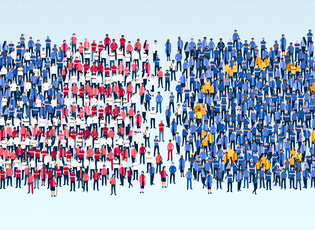
Trust in the transatlantic relationship is increasingly unequal, but support for cooperation remains strong, write Brandon Bohrn, Courtney Flynn Martino, and Daniela Schmidt in a new policy brief. New eupinions survey data show that while 73% of Europeans want greater independence, majorities on both sides of the Atlantic favour closer ties. 

Cover EU and USA
Policy Brief Banner without borders.

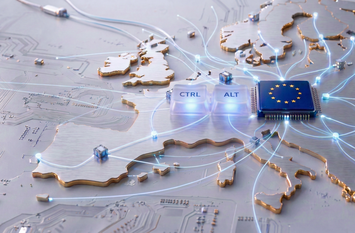
Policy Brief | CTRL + ALT + Europe?

Europeans want greater control over the digital technologies they rely on, even if many are unfamiliar with the term ‘digital sovereignty’. A new eupinions survey and policy brief by Martin Hullin and Daniela Schmidt show strong support for European alternatives, transparency and safeguards against foreign interference. The challenge is turning these expectations into resilient digital infrastructure.
What do Europeans want from digital sovereignty?

Fuel dispenser and E-charger

Op-Ed | Europe’s Auto Industry Needs a Better Deal

Germany and France have struck a deal on the future of Europe’s auto industry, trading stricter “Made in Europe” rules for more time for combustion-engine cars. Lucas Resende Carvalho and Daniel Posch argue that this risks undermining European competitiveness. To compete with China, they write, Europe must strengthen domestic production while maintaining a clear path towards electric vehicles.
What did the Franco-German compromise miss?

 
open bridge

Analysis | Beyond Tariffs: Europe Also Needs the Single Market to Respond to the China Shock

As the EU prepares tougher trade measures against China, Etienne Höra and Claudia-Dominique Geiser say tariffs alone will not restore European competitiveness. They can give industries breathing space, but lasting gains require deeper Single Market integration. This analysis argues that reducing internal barriers, supporting innovation and investing jointly are essential to strengthening Europe’s industrial base.
How can Europe react to China on trade?

Jake Benford

Analysis | The EU’s Security Partnership with the United Kingdom

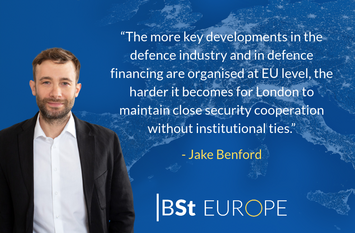
The EU–UK Security and Defence Partnership marks a step towards closer cooperation after Brexit. Yet, as Jake Benford explains, its broad geopolitical ambitions contrast with limited institutional commitments. Disagreements over defence financing and industrial cooperation reveal the challenges of turning shared security interests into concrete action.
More on the opportunities and limits of EU-UK cooperation


Stay tuned


Thank you for reading this edition of our BSt Europe newsletter!

Follow us on LinkedIn: linkedin.com/company/bst-europe

Follow us on Bluesky: bsky.app/profile/bst-europe.bsky.social