|
Dear Readers,
Last week’s informal European Council in Cyprus may well mark a turning point for the European Union. After months of deadlock, leaders finally agreed on a €90 billion support package for Ukraine and adopted the 20th sanctions package against Russia. Crucially, this breakthrough was made possible by the political shift in Hungary: with Viktor Orbán no longer acting as a veto player, long-blocked decisions could move forward. At the same time, discussions on the next Multiannual Financial Framework (MFF) for 2028–2034 have begun in earnest, heralding what will undoubtedly become one of the most contentious negotiation rounds in years.
This new political context is something we have been following closely and analysing from different perspectives. As Anna Heckhausen argues, Hungary’s recent election could fundamentally reshape the dynamics of the next MFF. The easing of veto constraints not only enables decisions like the Ukraine package; it also opens the door to stronger links between EU funding and rule-of-law compliance – an issue that is likely to sit at the heart of the upcoming budget negotiations.
The implications go beyond budgetary politics. The debate about Hungary has also reignited broader institutional questions within the EU. In a recent Deutschlandfunk interview, Florian Kommer comments on how developments in Budapest are fueling discussions on extending Qualified Majority Voting in the Council. This is an idea that, if pursued, could significantly alter the Union’s decision-making architecture in crucial areas.
At the same time, expectations for change in Hungary should remain tempered. As Daniela Schwarzer argues in her latest Handelsblatt op-ed, the end of the Orbán era may represent a turning point, but not an automatic transformation. Deep institutional reforms, sustained European engagement, and a complex geopolitical environment will shape what comes next.
Keeping up with these and other political developments, our experts have taken part in several recent events. Claudia-Dominique Geiser took a closer look at the European Commission’s “EU Inc.” proposal and its potential to strengthen Europe’s business environment. Brandon Bohrn examined the evolving transatlantic relationship under the current U.S. administration. And Martin Hullin discussed how Europe can advance its ambitions in AI, data, and cloud infrastructure to bolster technological sovereignty.
Best wishes,
Malte Zabel
Director, Europe’s Future Programme
|
|
|
|
|
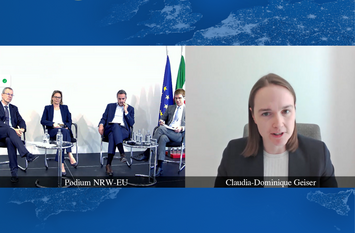
Event | EU Inc. Under Scrutiny: Investment Magnet or Minimal Compromise?
The European Commission’s “28th regime” proposal promises easier company formation, more capital, and better growth prospects, but can EU Inc. deliver? Claudia-Dominique Geiser, Dr. Nils Behrndt, Prof. Dr. René Repasi, and Maria Weiers discussed the strengths and limits of EU Inc., how to keep growing firms in the EU (and not have them move to the U.S.), the ins and outs of labour and corporate law in the EU, and much more. (In German)
Watch here
|

Why the Hungarian Election Matters for the Next MFF
Hungary’s recent election and the ensuing political shift have major implications for the EU’s next long-term budget, writes Anna Heckhausen. From easing veto blockages on Ukraine funding to testing rule-of-law conditionality, the election could reshape MFF negotiations and make stronger links between EU funds and compliance far more likely.
Read more
|
|
|
|
|

Interview | Hungary’s Election and Qualified Majority Voting in the EU
In this episode of Europa heute from Deustchlandfunk, the focus is on Hungary and Czechia. The developments in Budapest have ignited debates on expanding Qualified Majority Voting in the European Council, with perspectives in this episode by Florian Kommer. Meanwhile in Czechia, the Babis government is tearing up the country’s green agenda, driven by climate change sceptics leading the Environment Ministry. (In German)
Listen here
|

Op-Ed | Hungary After Orbán: A Turning Point for Europe?
Hungary’s new prime minister promises a democratic reset after years of Orbán’s rule, but expectations may outpace reality. This op-ed by Daniela Schwarzer argues that lasting change will require deep institutional reform at home, a constructive shift in EU policy, and stronger European support. However, entrenched Fidesz networks and geopolitical pressures remain a challenging context. (In German)
Read more
|
|
|
|
|

Event | What's Going on, America?
In the second year of U.S. President Donald Trump’s second term, the country has experienced profound changes with massive global consequences. At an Amerika Haus Nordrhein-Westfalen event, Brandon Bohrn and Klaus Brinkbäumer examine what these changes mean for Europe, and how the transatlantic relationship is evolving in these tumultuous years.
Read more
|
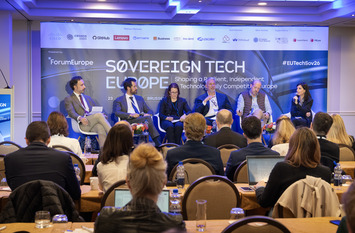
Event | Building a Sovereign and Interoperable Service in Europe
At the Sovereign Tech Europe Conference in Brussels, Martin Hullin moderated a discussed on how to turn Europe’s cloud and AI ambitions into reality. The session highlighted the need to balance innovation, regulation, and sovereignty to build a competitive, interoperable ecosystem that supports resilience, trusted infrastructure, and Europe’s broader goal of technological autonomy.
Read more
|
|
|
|
|
|
|
|
|
|
|
|
|
|


