|
Dear Readers,
Last weekend’s Shangri-La Dialogue in Singapore offered a blunt reminder of how transactional the global order has become. U.S. Secretary of Defense Pete Hegseth complained that security in the Indo-Pacific had rested on America’s shoulders for too long, while others had allowed their defence capabilities to wither. Although his tone towards China was more conciliatory, his message to Europe was pointed: Asian partners, he argued, had long understood that lasting partnerships are not built on idealistic values but on a concrete alignment of national interests. Western Europe, he suggested, could learn from that. For Europeans, this is another warning. In a world increasingly shaped by great-power rivalry, strategic partnerships will depend on the capacity to act. Europe cannot afford to be a spectator.
This is precisely the argument Daniela Schwarzer makes in her latest Handelsblatt commentary.The growing alignment between China and Russia, together with the evolving U.S.–China relationship, risks pushing Europe to the sidelines. To avoid this, Europe must strengthen its technological, industrial, and financial sovereignty, reduce strategic dependencies, and become more geopolitically capable.
But sovereignty is not only about defence and geopolitics in the narrow sense. At the Katapult Future Fest in Amsterdam, Martin Hullin, Daniela Schwarzer, Indy Johar and Tharald Nustar discussed how AI can strengthen societies rather than fragment them. Their debate moved beyond the familiar binary of innovation versus regulation and focused instead on democratic digital sovereignty, resilient institutions, and more ambitious cooperation across sectors.
Europe’s ability to act will also depend on the partnerships it builds. In Tokyo, Etienne Höra and Daniela Schwarzer joined discussions on closer cooperation between the EU and CPTPP countries. As Etienne writes in his recap, both sides share strong interests in defending multilateralism, advancing digital and green trade, and responding to economic coercion.
Taken together, these contributions confirm a simple but still valid conclusion: Europe’s future will depend on the practical capacity to act — with partners where possible, independently where necessary, and strategically at all times.
Best wishes,
Malte Zabel
Director, Europe’s Future Programme
|
|
|
|
|
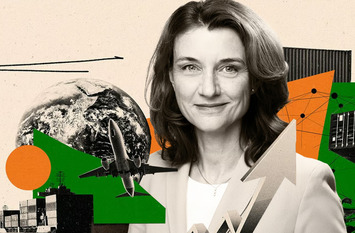
Op-Ed | Europe Is Living Under a Dangerous Illusion
The growing alignment between China and Russia, alongside the evolving U.S.-China relationship, is reshaping the global order. This commentary by Daniela Schwarzer argues that Europe risks being sidelined unless it strengthens its technological, industrial and financial sovereignty, reduces strategic dependencies and becomes more geopolitically capable in an era of intensifying great-power rivalry.
Read more (in German)
|
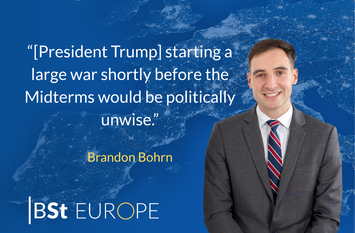
Trump Escalates the Crisis in Cuba: Regime Change or “Something Smaller”
Cuba is facing one of its worst crises in decades as energy shortages, supply problems and growing unrest fuel tensions with the United States. While Donald Trump increases pressure on Havana with threats and sanctions, Brandon Bohrn warn that even a limited U.S. intervention would be massively unpopular for U.S. voters, destabilise the island, and send a shockwave through regional geopolitics.
Read more (in German)
|
|
|
|
|
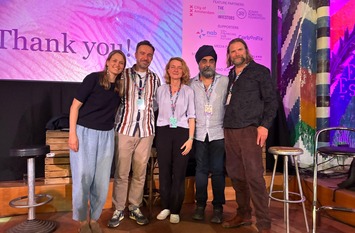
Event | Catapult Future Fest
At a session at the Katapult Future Fest in Amsterdam, Martin Hullin, Daniela Schwarzer, Indy Johar, and Tharald Nustar discussed how AI can strengthen societies rather than fragment them. The debate moved beyond simple binaries of innovation versus regulation, highlighting the need for democratic digital sovereignty, resilient institutions, and more ambitious cooperation across sectors.
Read more
|

EU–CPTPP: From Dialogue to Delivery
Etienne Höra and Daniela Schwarzer joined discussions in Tokyo highlighting growing momentum for closer cooperation between the EU and CPTPP countries. As geopolitical tensions reshape global trade, both sides share strong interests in defending multilateralism, strengthening digital and green trade, and addressing economic coercion, writes Etienne in a summary of the conference.
Read more
|
|
|
|
|
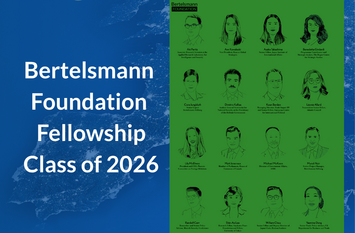
2026 Bertelsmann Foundation Fellowship | Exploring the Future of U.S.-EU-Asia Dynamics
The 2026 Bertelsmann Foundation Fellowship is a seven-month hybrid exchange focused on transatlantic policy coordination and stakeholder dialogue. For the first time, this long-running fellowship brings together professionals, including our own Cora Jungbluth and Murali Nair, from North America, Europe, and Asia to explore the evolving U.S.–Europe–Indo-Pacific relationship.
Read more
|

Event | Confidence Through Renewal
The Bertelsmann Stiftung’s Diplomacy Circle brought European diplomats to East Westphalia to explore how Germany’s future is shaped beyond Berlin. As Malte Zabel recounts, the retreat highlighted the role of regional innovation, local government, state modernisation, and European cooperation in strengthening social cohesion and managing transformation.
Read more
|
|
|
|
|
|
|
|
|
|
|
|
|
|


