>

Dear Readers,

The war in Iran remains a major headache for Europeans. It may be “not our war” (as Kaja Kallas put it), but its consequences certainly are. They are clearly visible at the petrol pump—and this may be only a foretaste of broader economic repercussions yet to come for all Europeans. It is therefore no surprise that both the conflict in Iran and economic concerns featured prominently on the agenda of last week’s EU summit. The overarching goal is clear: Europe’s economy must become more resilient so that the EU is less vulnerable to external shocks as quickly as possible.

One key lever in this effort is Europe’s budget. Negotiations over the next Multiannual Financial Framework (MFF) are already underway and will soon intensify. High time, then, for a comprehensive guide to this highly complex dossier. Lucas Guttenberg and Anna Heckhausen have done exactly that. Their paper, “The Devil is in the Budget,” is your go-to guide for understanding the upcoming MFF negotiations. The central challenge is that the next MFF will be negotiated under tight political and fiscal constraints with high expectations. The outcome will hinge on difficult trade-offs shaping the next seven years.

At the same time, Europe’s resilience will depend not only on its fiscal framework, but also on the strength of its trade and industrial policy toolbox. This is particularly evident in Europe’s response to what some call “China shock 2.0.” In her latest Handelsblatt op-ed, Daniela Schwarzer argues that Europe should strengthen its trade defence instruments, pursue a more assertive industrial policy—including through the proposed Industrial Accelerator Act—and reduce critical dependencies.

Ultimately, however, resilience must also be built at home. Europe’s first major asset remains the completion of the Single Market—“One Europe, One Market,” as the European Council conclusions put it. In this context, the Commission has recently presented its proposal for a so-called 28th regime for company formation, branded “EU Inc.” In this post, our Single Market expert Claudia-Dominique Geiser explains what truly matters for the 28th regime, and why it would make sense to begin with regulatory pilots.

And speaking of resilience starting at home, this mapping of societal preparedness by Helena Quis and Lena Schmalhorst highlights, through a number of flagship examples, the extent to which capabilities in civil defence already exist across Member States. That is certainly encouraging.

With that in mind, best regards,

Malte Zabel

Director, Europe’s Future Programme

 
Pins on a geographic map curved like mountains. Pinning a location on a map with mountains.

Policy Brief | The Devil is in the Budget

The EU’s next Multiannual Financial Framework—its budget—will be negotiated under intense fiscal pressure, rising spending demands, and disputes over priorities. This comprehensive guide by Anna Heckhausen and Lucas Guttenberg explains how the MFF works and highlights five key battles that will shape the outcome for the 2028-2034 EU budget.
Read more

ire fighter men and women doing some teambuilding stacking hands

Analysis | Societal Preparedness in Europe: Mapping Civil, Community and Citizen-led Initiatives

Europe faces an increasingly complex risk landscape, from cyberattacks and disinformation to natural disasters and geopolitical tensions. This mapping by Lena Schmalhorst and Helena Quis shows how societal preparedness depends on informed, engaged citizens, highlighting diverse community-led initiatives across Europe and offering insights to inspire mutual learning and stronger resilience.
Read more

 
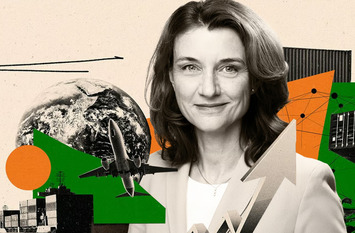
Daniela Schwarzer at Handelsblatt (newspaper)

Op-Ed | China Shock 2.0 and Europe’s Response

In Handelsblatt, Daniela Schwarzer argues that China’s new Five-Year Plan is intensifying a “China shock 2.0”, increasing competitive pressure and the risk of new dependencies in key industries. She calls on Europe to respond by strengthening trade defence, advancing a more assertive industrial policy including through the Industrial Accelerator Act, and reducing critical dependencies. (In German)
Read more

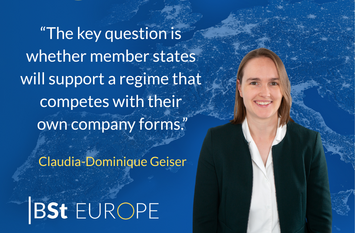
Claudia-Dominique Geiser

The EU Inc. Proposal is Out – What it Means and What to Watch

The Commission’s new “EU Inc.” proposal aims to create a single, digital company framework across the EU. The goal is faster setup, flexible financing, and less bureaucracy for EU businesses. Claudia-Dominique Geiser explains that this ambitious endeavor could face issues on the legal basis, dispute resolution, and employee participation could shape tough negotiations ahead.
Read more

 
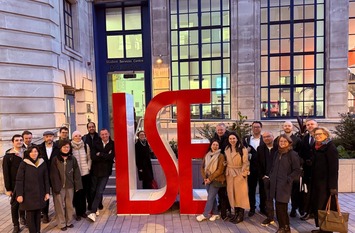
People in front of a building (Open European Dialogue’s Policy Mission London Residency Week

Our Experts Join the Open European Dialogue’s Policy Mission Fellowship

At the Open European Dialogue’s Policy Mission London Residency Week, Thomas Schwab and Martin Hullin joined fellows and members of parliament across Europe to explore the “securitisation of Europe’s economic power”. Expert insights and workshops on long-term trends highlighted a core gap: Europe has the capability but lacks the connective tissue to act collectively. Check out the daily recaps of the sessions.
Read more

New China Commission formed by German Bundestag

New China-Commission Formed by the German Bundestag

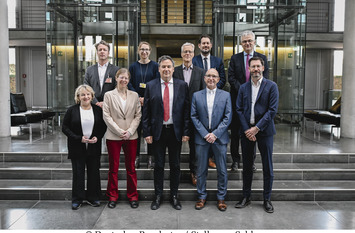
The German Bundestag has established a new China Commission to review security-relevant economic ties with China, and our China expert Cora Jungbluth is a member. Bringing together experts from academia, industry, and policy, the body will assess dependencies in supply chains, investment risks, and “de-risking” strategies. It aims to advise and inform Germany’s economic security approach. (In German)
Read more


Stay tuned


Thank you for reading this edition of our BSt Europe newsletter!

Follow us on LinkedIn: linkedin.com/company/bst-europe

Follow us on Bluesky: bsky.app/profile/bst-europe.bsky.social