Dear Readers,
The Munich Security Report 2026 underscores three new realities for Europe: a fundamentally challenged transatlantic relationship, declining political and institutional trust across Western democracies, and Europe’s own leverage which will only matter if it is actively used.
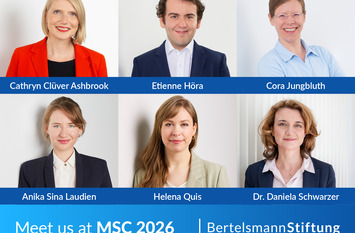
Our engagement at this year’s MSC speaks to all three topics. Our side events and panel contributions focus on Europe in a changing global order, resilience, transatlantic relations, and the future of strategic cooperation.
We kick off our activities on Thursday evening with an event on Human Thriving in an Age of Spiking Conflict at the Emerging Leaders Hub. You are welcome to still sign up for the discussion on Europe’s Hidden Strengths: Why We Have More Negotiating Power Than We Think. Together with Philippa Sigl-Glöckner of the European Macro Policy Network, I will take a closer look at European leverage points: from access to 450 million affluent consumers to key products essential for Trump’s energy and AI push.
Our official MSC side event on Shifting Powers, Changing Blocks: Scenarios for Europe in a Fragmented World 2035 is overbooked, unfortunately. But the underlying study exploring six scenarios for the global power order in 2035 will be published tomorrow! It is designed to help European decision-makers prepare for an international environment whose direction is increasingly uncertain. Please check our website and social media for this update!
Security debates at the MSC are pushing the boundaries into new domains. Space is one of them. In a new policy brief, Torben Schütz shows how Europe’s growing investment in space sits at the intersection of security, sovereignty, and industrial policy. Speed matters, but so does control. Commercialization can accelerate innovation, yet long-term resilience will require deliberate choices about dependencies, procurement, and a realistic “buy European” strategy. As competition in orbit intensifies, Europe’s room for strategic hesitation is shrinking.
We also look forward to a special screening of Astropolitics, the new Bertelsmann Foundation documentary by Tony Silberfeld. The film explores the geopolitical significance of space at a time when governance, competition, and security are becoming inseparable. Participation is open with registration required.
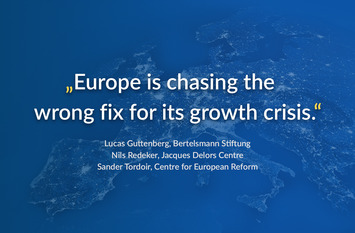
Europe’s economic unease will also be impossible to ignore in Munich. In Politico, Lucas Guttenberg, Nils Redeker, and Sander Tordoir argue that Europe is chasing the wrong fix for its growth crisis. The deregulation and simplification agenda promises far more than it can deliver. The authors suggest a better agenda: rooted in national reform, a more strategic trade policy and a focused industrial approach that can turn Europe’s green transition and single market into sources of power.
We are very much looking forward to putting our analyses and recommendations up for debate at Munich Security Conference and seeing many partners and colleagues across disciplines and institutions. Please get in touch!
Best wishes,
Daniela Schwarzer
Member of the Executive Board